Choosing a 180 mm Japanese santoku, including the Masamoto KA kurouchi
People asking "which santoku?" or "who makes this santoku?" are usually deciding between a few things: how much care they will give a carbon blade, whether they want iron cladding and a rustic finish, and how to read the maker information on an unfamiliar knife. A 180 mm blade is the size most often requested, long enough to be a main knife for a home cook and short enough to be easy to control.
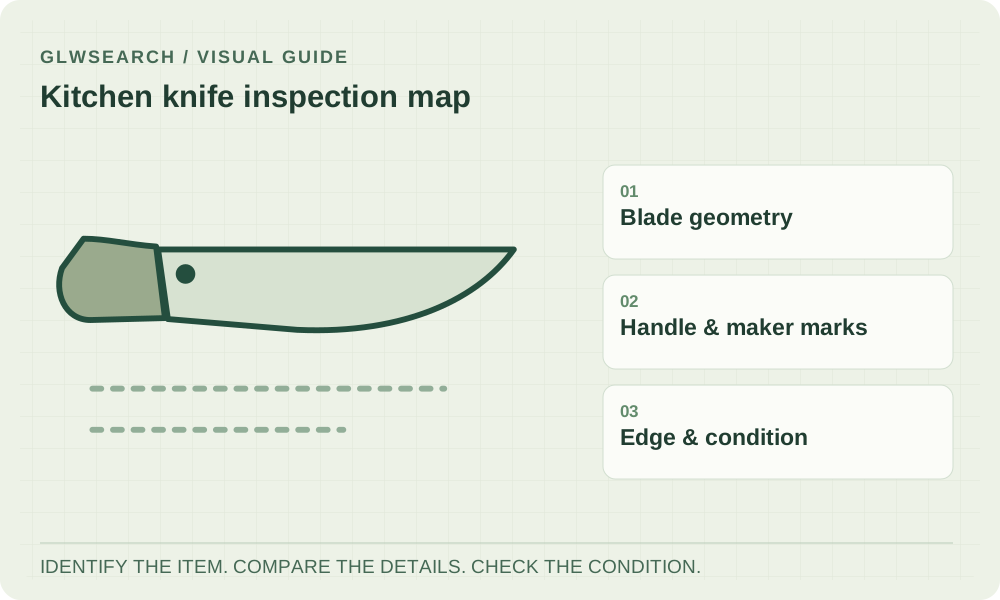
In this guide
What a santoku is
Santoku means "three virtues" or "three uses", variously explained as meat, fish and vegetables, or as slicing, dicing and chopping. The style dates from the 1940s and is a general-purpose knife that combines features of traditional Japanese knives.1 Standard blade length is roughly 15 to 18 cm.1
The profile is distinctive:
- A fairly straight cutting edge and a rounded "sheep's foot" tip rather than a sharp point.
- A tall blade, which gives knuckle clearance and a flat surface for scooping food.
- Shorter, thinner and lighter than a typical European chef's knife; it relies more on a straight downward cut than on rocking.1
A 180 mm santoku is a good fit for vegetables, boneless meat and fish fillets. It is less suited to heavy chopping, bones, or tasks that need a long slicer. If you prefer rocking on a board, a gyuto may feel more natural.
Carbon, semi-stainless or stainless
This is the main choice. Retailer guidance generally says the following.2
| Type | Examples | Behaviour |
|---|---|---|
| Carbon | Aogami (Blue) #2, Shirogami (White) #2, Takefu V2 | Easy to sharpen, very keen edge, rusts if left wet, develops patina |
| Semi-stainless | SKD-series examples (confirm the grade) | Better corrosion resistance than carbon, still needs drying |
| Stainless / powder stainless | VG10, SG2 | Low maintenance; powder steels hold edges well but are harder to sharpen |
Forum users advise not to over-generalise about steel brittleness, because heat treatment matters as much as the steel type (opinion of forum posters).3 If you will not wipe and dry a knife after every use, choose stainless or semi-stainless. If you enjoy care routines, carbon rewards you.
Cladding and finish
Many traditional santoku are laminated: a hard core between softer cladding. Iron cladding is reactive and will discolour; stainless cladding is not. A request for "iron cladding" in the forum thread is a request for the reactive, traditional look, and with it comes patina.3
Kurouchi means "black forged": the dark forge scale is left on the blade rather than polished away. Three versions exist: natural scale, lacquered, and an artificial finish applied by black oxide or acid bath. The finish is mostly visual and traditional, and cutting performance depends on geometry, steel and sharpness.4 Natural kurouchi can wear and transfer slightly in early use.4 If a listing says "kurouchi" at a low price, check whether it is natural or an artificial coating.
Masamoto KA series
Masamoto Sohonten was founded in Tokyo in 1866 by Minosuke Matsuzawa and is now run by its sixth generation, according to a US importer.5 Its product lines include Shirogami and Aogami hongasumi knives, VG-10 and virgin carbon steel ranges.5
The KA series is described by retailers as Masamoto's Aogami (Blue) #2 range, with a core at 62 to 63 HRC forge-welded and sandwiched with soft iron, a D-shaped magnolia handle with a water-buffalo-horn ferrule, and a hand-sharpened edge.6 A Japanese retailer's page for a KA Hon Kasumi santoku lists a 170 mm size, a 50/50 double bevel, and care advice: hand wash only, avoid prolonged water contact, oil after use, store dry, and avoid bones and frozen food.6 Some retailers also list a KA kurouchi wa santoku, which should be the same Aogami #2 steel with the forge-scale finish; confirm with the seller.
Check carefully when shopping:
- The documented KA santoku is 170 mm. A standard 180 mm KA kurouchi is not confirmed by a source here, so confirm the length the seller is actually listing.
- A forum poster in the santoku thread recommended a KA blue-steel santoku and described the KA line as ranking above Masamoto's KS entry level, a comment from owner opinion rather than from Masamoto.3
- Masamoto series letters (KA, KS, VG, CT, HC) denote different steels and finishes. Do not treat a "Masamoto" name alone as meaning blue steel.
Other makers people suggest
Posters in one forum thread named, among others: Yoshikane SKD (described as stainless-ish with a hard 64 HRC, praised for its heat treatment), Wakui Shirogami 2, Hinoura carbon, Moritaka AO2, Kaeru kurouchi, and Takeo Murata.3 These are personal recommendations, not rankings. Retailers cited there include European and Japanese dealers; check live listings and policies for any shop.
Identifying a maker from stamps
There is no universal public registry of kitchen-knife stamps, and a marking on its own is weak evidence. A more reliable approach:
- Photograph the full blade, both sides, and the tang area if the handle is removable, in good light.
- Note the kanji or logo exactly. Maker marks are often stamped; on some makers' work they are hand-chiseled, which is a documented convention for at least Shigefusa's single-bevel kitaeji knives.7 Do not generalise that to other makers.
- Post clear photos on a specialist knife forum and ask which makers use that mark, and treat answers as opinion until a retailer or the maker confirms.
- Compare with photos on reputable retailers' pages for the same line.
- Be careful with names that appear similar across makers (for example, "HMA" or "Hiro" initials appear on various knives). Attributing a knife to a maker based on partial letters alone is unreliable.
Sharpening
Japanese knives are usually sharpened at about 15 to 17 degrees per side.8 A practical workflow from retailer guides:
- Start on a 1000-grit stone for routine work, a coarser 200 to 400 stone only to repair chips, and finish on 3000 to 5000 grit. Higher grits are unnecessary for general kitchen use.98
- Find the angle with a coin or two coins under the spine, and keep it consistent.89
- Work the whole edge, not just the belly, until a burr forms along the full length, then remove the burr with light alternating strokes.98
- Flatten the stone periodically.8
- Follow the maker’s sharpening advice. Japanese Knife Imports recommends water stones and cautions against honing rods on harder or more brittle knives, suggesting a strop or finishing stone instead.10
Common mistakes
- Leaving a carbon knife wet or in a sink, or putting it in a dishwasher.
- Using the knife on bones, frozen food or glass and stone boards.
- Sharpening at too steep an angle or only part of the edge, which distorts the profile.
- Pressing too hard when the burr has already formed; extra strokes after a burr do not make the edge sharper.9
- Treating stamp or brand names as proof of steel or maker.
Carbon care in short
Wipe during use, dry straight after washing, and keep a thin film of camellia or food-safe mineral oil on the blade for storage. A grey, blue or brown patina is protective; orange, powdery spots are rust, and can be removed with a baking-soda or Bar Keepers Friend paste.11 Load a magnetic strip spine-first.11
Santoku, nakiri or a short gyuto?
Choose by the movements you actually use at the board. Before ordering an unfamiliar shape, measure your current knife's cutting edge and ask what you would change: length, height, weight, tip or maintenance.
| Preference | A useful shape to compare |
|---|---|
| One compact knife for everyday preparation | A 165–180 mm santoku |
| Mostly vegetables and a broad, rectangular blade | A nakiri |
| More tip work or a longer slicing stroke | A gyuto |
Japanese Knife Imports identifies a gyuto or santoku as a sensible first general-purpose Japanese knife and notes that workspace affects the appropriate length.10 That is a starting point for comparison, rather than a promise that one profile suits every cook.
Is a 170 mm santoku a bad substitute for 180 mm?
Not automatically. Compare the actual heel-to-tip measurement, blade height and usable edge. A seller's nominal size is less informative than a photo beside a ruler and the dimensions of the knife you already find comfortable. For the Masamoto KA, search the series and documented size together so that a different Masamoto line does not slip into the shortlist.
What should an unidentified santoku listing show?
Ask for both blade faces, the maker mark, the spine, a safe close-up of the heel and the handle fit. Request the stated steel, cladding and length separately. A dark finish answers a finish question; it does not establish the steel or maker. If the seller cannot identify the line, compare it as an unidentified knife rather than pay for an unverified attribution.
Sources and further reading
- Santoku, Wikipedia: origin, name and profile.
- Carbon vs stainless steel, Chef's Edge: retailer comparison.
- Which Santoku?, Kitchen Knife Forums: forum recommendations, opinion only.
- What Is a Kurouchi Knife?, Cutlery and More: retailer explanation.
- Masamoto Sohonten, Korin: importer's account of the company.
- Masamoto KA series Hon Kasumi Blue Steel No.2 Wa Santoku 170 mm, Japanese Chef's Knife: retailer specifications and care notes.
- Craftsman Tokifusa Iizuka FAQ, Knives and Stones: retailer FAQ on Shigefusa marks.
- How to sharpen a knife on a whetstone, Chef Knives To Go: retailer guide.
- How to sharpen a Japanese knife on a whetstone, Knives and Stones: retailer guide.
- Choosing and sharpening Japanese knives, Japanese Knife Imports FAQ: retailer’s own guidance on knife shape, size and sharpening.
- Carbon Steel Knife Care Guide, Chef Knives To Go: retailer care guide.