Buying a Mortal Kombat II, Street Fighter III or Marvel vs. Capcom 2 arcade machine
These three 1990s fighting games are often wanted together by collectors, and a "dedicated" cabinet is usually the goal: a machine built for that one game, with its own artwork and control panel, rather than a generic cabinet or multi-game box. The three run on entirely different hardware, and that changes what can go wrong. One collector on the Arcade Museum forums, for instance, wanted a full Mortal Kombat II cabinet while being open to circuit boards for the other two.1
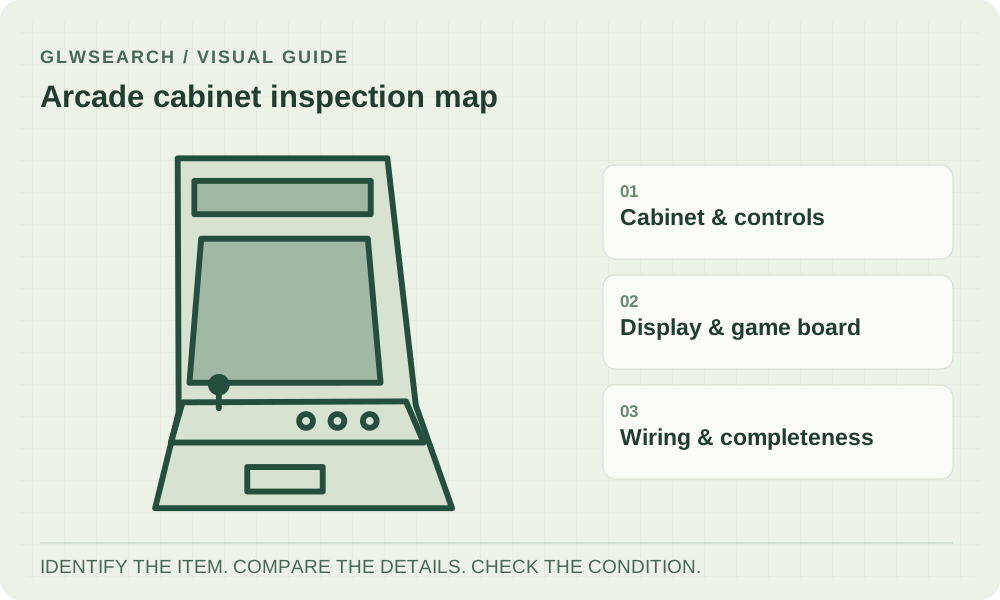
In this guide
Hardware at a glance
| Game | Maker | Arcade hardware | Arcade release |
|---|---|---|---|
| Mortal Kombat II | Midway | Midway T Unit board | November 1993 (North America)2 |
| Street Fighter III series | Capcom | CP System III (CPS-3) | New Generation and 2nd Impact 1997, 3rd Strike 19993 |
| Marvel vs. Capcom 2 | Capcom | Sega NAOMI | Japan March 2000, North America May 20004 |
Mortal Kombat II
Wikipedia reports about 27,000 arcade units sold in total, and that the final software version was 3.1, released in January 1994, after earlier revisions including a public beta (1.4).2 The Killer List of Videogames entry (Arcade Museum) lists an upright cabinet weighing 343 pounds, an 8-way joystick with five buttons (high and low punch, high and low kick, block), two players, a horizontal colour raster monitor and Midway's DCS audio system.5 It also lists the conversion class as JAMMA, so treat the entry as a specification summary and check actual cabinet markings.5
Checks specific to this game: ask which software revision is installed (3.1 is the final), confirm the control layout is the original five-button panel, and look at the marquee and side art for fading, replacement vinyl or reproduction decals. Because so many were made, many survivors have been repaired or converted. A genuine dedicated cabinet should have Midway labels, a serial plate, and a board set consistent with the cabinet.
Street Fighter III
The series has three arcade versions, New Generation, 2nd Impact and 3rd Strike, all on CPS-3.3 Wikipedia notes 3rd Strike exists in several arcade revisions, with the third revision removing the unblockable attacks for some characters; ask a seller which revision is installed if it matters to you.6
The CPS-3 battery problem
CPS-3 is Capcom's last proprietary arcade board. Games load from CD, and a separate security cartridge holds the BIOS and the SH-2 CPU with decryption logic. Each game's decryption key is kept in battery-backed memory.7 If the cartridge is tampered with or the battery dies, the game becomes unplayable; the 2nd Impact release is an exception because it uses default keys that work even with a dead cartridge.7
A forum thread on Arcade Controls describes a dead battery as showing coloured stripes and no sound, and one poster warned that home users may drain the batteries faster than arcade operators, while noting that repair services existed and that Capcom used to repair boards for a fee.8 Treat those as owner reports. The practical advice:
- Boot the actual machine, run it through attract mode and a game, and leave it powered on to confirm it behaves.
- Ask whether the cartridge has ever been opened or repaired, and by whom. Do not open it yourself.
- Know that Wikipedia reports the encryption was reverse-engineered in 2007, enabling emulation and a "super cartridge" for running all CPS-3 games.7 A seller should disclose whether such a replacement is in the machine, since it affects originality.
- Check the CD drive and disc and that modules are seated. A buyer-oriented thread lists the CHR1, CHR2, PRG1 and SND1 module slots as things to verify.8
On the forum thread that prompted this guide, one member said 3rd Strike cabinets are hard to find, recommended contacting overseas sellers directly, and mentioned a "Super BIOS" option for CPS-3.1 Those are opinions from one member.
Marvel vs. Capcom 2
Wikipedia describes this as Capcom's first fighting game outside its CP System II and III hardware, running on the Sega NAOMI.4 NAOMI uses a Hitachi SH-4 and PowerVR graphics, and games can be on ROM boards, optionally with a GD-ROM drive that loads to a DIMM board.9 When buying, confirm the actual game media in the board. NAOMI is also used for many other games, so a NAOMI cabinet may be set up for another title and re-labelled or switched. The Arcade Museum entry has little detail beyond the basics, and shows very few collectors owning this game, which says little about condition but suggests limited reference material.10
A forum member in the thread suggested contacting a Miami seller who might have an MvC2 with a NAOMI system, and suggested saved searches on classified sites.1
What "dedicated" should mean, and how to verify
A dedicated cabinet is one made for the game: matching side art, marquee, bezel and control panel layout. You can check:
- Artwork and panel. Compare with photos on the Arcade Museum (KLOV) entry and Wikipedia. Original panel layouts have a specific button count and arrangement.
- Board and cabinet pairing. The board set should match the game, with matching labels. Boards swapped into a cabinet from another game, or a multicade with a generic panel, are conversions.
- Monitor. Look for burn-in, geometry problems, a repaired chassis and a check that the picture is stable after warming up. CRT monitors and power supplies can hold dangerous charge; leave service to a qualified arcade technician.
- Wiring and power supply. Check for patched harnesses and a replaced power supply, and have any non-original modifications explained.
- Emulation risk. Software emulators such as MAME document these games and hardware; use that documentation for reference, but note that a cabinet running a PC or Raspberry Pi is not original hardware.
Where to look for reference
- Killer List of Videogames (Arcade Museum) for specifications and cabinet photos.5
- Wikipedia for hardware and version history.79
- Capcom and Midway service manuals for the specific cabinet or board where available; collector communities share scans.
- Arcade Museum forums for sales and wanted ads and technical questions, noting that posts are individual opinion.1
Write the listing down in three separate parts
When comparing arcade machines, separate cabinet, game hardware and display. A desirable original cabinet can contain replacement electronics; an original board set can be installed in a different cabinet. A modern reproduction can still be enjoyable, but it should be described and priced on its actual contents.
| Buying priority | Proof to request |
|---|---|
| Original Mortal Kombat II cabinet | Cabinet labels, complete artwork photographs and a view of the installed board set |
| A specific Street Fighter III version | Boot and title screens, hardware identification and disclosure of cartridge modifications |
| Marvel vs. Capcom 2 on NAOMI | A view of the installed hardware and a demonstration of the actual game booting |
| A machine ready for regular play | Demonstration of both players' controls, sound and a stable picture |
Have the seller film a startup rather than only a game that is already running. Then ask for a demonstration of both joysticks and every button. Request disclosure of replaced boards, monitor work, artwork, harness changes and any emulator or multicade installation. These details help you compare like with like without turning a short advert into a technical assumption.
Is a converted cabinet always a poor purchase?
Not necessarily. Decide whether you value original construction, the game experience or both. A clearly disclosed conversion is easier to assess than a machine described as "dedicated" without supporting photographs.
What should I measure before collection?
Confirm the seller's actual cabinet dimensions and weight, plus the narrowest door, stairway and access route at your destination. Get a transport quote and establish who is responsible for loading and securing the machine.
Sources and further reading
- WTB: MK2, Street Fighter 3, or Marvel Vs. Capcom 2, Arcade Museum Forums: wanted thread and replies.
- Mortal Kombat II, Wikipedia: release, hardware, revisions, units sold.
- Street Fighter III, Wikipedia: versions and CPS-3.
- Marvel vs. Capcom 2: New Age of Heroes, Wikipedia: NAOMI hardware and release.
- Mortal Kombat II, Killer List of Videogames (Arcade Museum): specifications and cabinet details.
- Street Fighter III: 3rd Strike, Wikipedia: release and arcade revisions.
- CP System III, Wikipedia: hardware, security cartridge and battery.
- Arcade Controls forum thread on CPS3: owner reports on dead batteries and repair.
- Sega NAOMI and other arcade system boards, Wikipedia: NAOMI hardware.
- Marvel VS. Capcom 2, Killer List of Videogames (Arcade Museum): entry and census information.