Binion's Horseshoe WSOP Paulson tournament chips
Collectors who want "Binion's WSOP Paulson T25s" are chasing the lowest denomination of the Paulson tournament chips used at the World Series of Poker when it was played at Binion's Horseshoe in downtown Las Vegas. The set is one of the few tournament chip series with a famous venue behind it, which is why it attracts so much attention. The details below come mostly from collector discussions, so they are labelled as such.
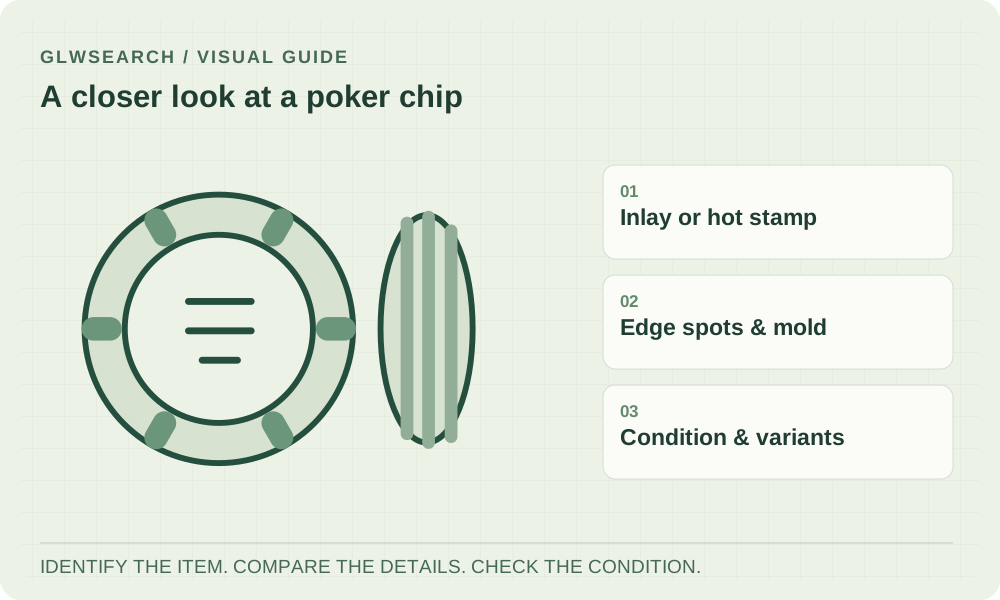
In this guide
The venue in brief
Benny Binion bought the Eldorado Club and Hotel Apache in 1951 and reopened them as Binion's Horseshoe. Jack Binion started the World Series of Poker there in 1970. In 1988 the casino absorbed the neighbouring Mint, which let it open its first dedicated poker room. After Ted Binion lost his gaming licence in 1998, his sister Becky Behnen took control; in January 2004 federal marshals seized about $1 million from the cage over pension obligations. Harrah's Entertainment bought the property and sold the brand and assets to MTR Gaming Group on 11 March 2004, and TLC Casino Enterprises acquired the property in 2008. It now operates as Binion's Gambling Hall and Hotel.1
The Horseshoe also expanded into the demolished Boulder Club site next door in 1961.2
What chips the WSOP used, by period
A collector-compiled summary of WSOP chip usage on the Poker Chip Forum gives the following for the Binion's years. Treat it as a community reference, not an official record.3
| Period | Chips |
|---|---|
| 1970-1978 | Cash chips in $1, $5, $25 and $100 |
| 1979-1983/1986 | Horseshoe house chips in $5 to $1,000, with unusual colours noted at the finals |
| 1987-1990 | First Paulson set: $5 to $500 in an 8V pattern, $1,000 in quarter-pie, $5,000 in the 4TSA18 pattern |
| 1991-1992 | Paulson for the lower values, Bud Jones for $5,000 and $10,000 |
| 1993-1996 | Paulson $25 and $100, Bud Jones $500 to $10,000 |
| 1997-2003 | Paulson and Bud Jones, with changes to the $10,000 and a $25,000 added around 2000-2001 |
| 2004 | Bud Jones set only, used one year before the event moved to the Rio |
Another forum thread on the same chips describes the T25 as the green chip in the Paulson series and lists the denominations T5, T25, T100, T500, T1000 and T5000, with T500 and T5000 pieces called very scarce by posters.4
Where the chips came from
The thread on Binion's WSOP Paulson chips repeats a story that the Binion family held on to chips after the casino closed, even though Nevada gaming rules required chips from a closed casino to be destroyed, and that someone then sold them as singles online for many years. It mentions a photo said to show a storage unit containing a very large number of chips and states that roughly 650,000 chips were involved.4 That is unverified collector lore. The Nevada regulations are not quoted on those pages, and nothing there documents the volume.
Telling genuine chips from imitations
The pages read do not describe a verification method, and they do not say whether reproductions exist. Practical steps:
- Identify the denomination, colour and mould. Compare with photos in the ChipGuide and in forum catalogue threads. The 8V edge-spot pattern and the 4TSA18 pattern for the $5,000 are referenced above.
- Look for casino-use wear. The thread describes varying wear patterns by denomination, consistent with chips that were used in play before being stored.
- Be wary of "WSOP" chips from later years. After 2004 the series moved to the Rio and used different chips, so a chip claimed to be Binion's must match the 1987-2003 designs.
- Ask sellers for provenance and photographs of both faces and the edge.
Collecting notes
Most collectors want a complete set from one year, but the mix of Paulson and Bud Jones chips after 1990 means a full "Binion's WSOP" rack is made up of two makers' chips for most years. A collector building a rack of only Paulson chips can focus on 1987-1990, where the set was entirely Paulson.
Building a Binion's WSOP denomination checklist
Decide whether the aim is a representative sample, a playable tournament set or a display tied to a particular period. These goals create different shopping lists. A sample needs the relevant denominations; a playing set also needs enough low-value chips for starting stacks and enough larger chips for later rounds.
For each candidate, record the printed denomination, maker attribution, spot pattern, diameter and source photograph. Include a separate field for the years in which a reference says it was used. The mixed-maker timeline above makes this distinction important: a group of chips from Binion's is not automatically a complete set used in one WSOP year.3
Search terms that narrow the results
Binion's WSOP Paulson T25, Binions Horseshoe tournament 25 chip and Binion's WSOP 1987 chip set target the collector subject more closely than WSOP chips. Add the denomination you need, rather than assuming a high-value chip belongs to the same Paulson run as the T25.
What should an auction photograph show?
Ask for a straight-on photograph of each denomination and an angled edge view. A group photograph helps with inventory, but it is poor evidence for one difficult-to-find value. Wear, a familiar color or a plausible storage story cannot authenticate a specimen on their own; compare its actual design with the period-specific references.
Sources and further reading
- Binion's Gambling Hall and Hotel, Wikipedia: history of the venue.
- Boulder Club, Vintage Las Vegas: Boulder Club history and demolition.
- WSOP Chip Usage, Binion's Horseshoe, Poker Chip Forum: collector-compiled usage by year.
- Binion's WSOP Paulson chips info, Poker Chip Forum: discussion of denominations, scarcity and the stored-chips story.