Fake, fantasy and counterfeit casino chips, and where to get a second opinion
Collectors who want original chips, not reproductions, say so in wanted threads, and for good reason: fantasy chips, souvenir sets and genuine counterfeits all circulate, along with real chips that have been altered. This article explains the differences and the checks that help.
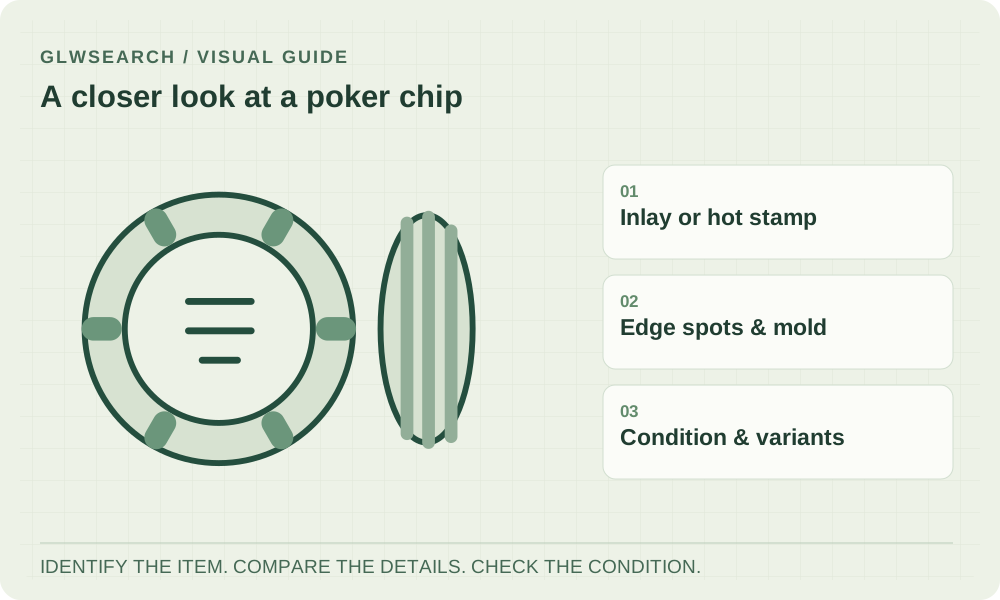
In this guide
Four things people call "fake"
- Fantasy chips are produced with a fictitious casino name, often for films or events. The Casino Collectibles Association (CCA) distinguishes them from counterfeits: fantasy chips are legitimately produced, while counterfeits illegally mimic real casinos.1
- Novelty or souvenir reproductions are mass-produced home-game chips, often glossy with a generic casino logo. They are not made to deceive.2
- Counterfeits are made to deceive collectors or casinos. The CCA says brass-core counterfeits circulated from 2001, that genuine examples show injection marks while fakes can have smooth, hand-sanded edges, and that it keeps a list of known counterfeits including Harrah's, Crystal Bay Club and Ranch House chips in various denominations.1
- Altered chips are legitimate chips modified to look rarer, which reduces their value. Casino Collectibles News lists them as a separate category.2 Relabeled or "murdered" chips are a related case: they are not necessarily fraud, but they should be disclosed (see the relabel article).
Signs worth checking
Casino Collectibles News, a long-running collector publication, lists these indicators: lighter weight, rough or uneven edges, errors in the inlay or hot stamp and inconsistent colors, a different sound or feel, and denomination or casino mismatches. It suggests a UV light test (many authentic chips show a pattern or logo), comparing weight with the expected 8.5 to 10.5 g range, and magnifying edge spots and inlays.2 The CCA adds caution about unusual colors and about chips in unused condition when a counterfeit is known for that casino.1
Remember the limits of these tests. Weights vary by maker and era (Wikipedia gives a worldwide range of 8 to 16 g), UV features differ by chip, and a leaded chip may weigh more than 11 g.3 4 No single test settles it. The best approach is a cluster of consistent clues: material, weight, mold, edge spots, inlay or hot stamp, and condition all pointing to the same story.
A reproduction hot stamp or inlay on a real blank is the hardest case. Compare the lettering, color and depth with a known genuine example, such as those in the Museum of Gaming History's ChipGuide.5
Buying safely
The CCA's guidance includes:1
- Ask the seller directly whether a chip is authentic, and ask about condition by email instead of relying on photos alone.
- Check shipping charges in advance, because inflated shipping is a common auction trick the CCA warns about.
- Ask if the seller is a CCA member, since members agree to a code of ethics requiring truthful disclosure.
- Post scans on a collector forum for identification.
Never assume a price or listing is reliable; check live listings and several sellers.
Where reputable references and communities are
| Resource | What it offers |
|---|---|
| Casino Collectibles Association (formerly the Casino Chip & Gaming Tokens Collectors Club, founded 1988) | Education FAQs, grading standards, the Casino Collectible News magazine and annual conventions6 |
| ChipGuide, Museum of Gaming History | Online catalog of casino chips operated by the CCA5 |
| Poker Chip Forum | Large community for identification, mold discussion and trades; treat posts as member opinion |
| Gaming Partners International SEC filings | Manufacturer's own account of brands and chip types7 |
A forum member notes that Chiptalk, an earlier forum from the poker-boom years, held much chip history that was lost when it closed, and that the Wayback Machine preserves only limited parts of it.8
A second-opinion packet that is useful to an expert
A blurry auction screenshot rarely supplies enough information to distinguish an original, a fantasy issue and an altered chip. Assemble the object-level evidence before asking for a verdict:
- A straight-on photograph of each face, plus an edge view.
- The exact venue name, printed denomination and any city or state.
- Measured weight and diameter, with the instruments described.
- A link to the listing and the reference example you think matches it.
- The seller's disclosed alterations, cleaning or replacement artwork.
Ask a focused question: 'Does this inlay match the documented issue?' is more answerable than 'Is this valuable?' If the issue is originality, do not let a discussion drift into whether the chip would make a nice relabel project.
Evidence to preserve before a purchase
Save the photographs and listing description, especially claims such as 'original', 'uncirculated' or 'from the casino'. Check the return conditions while the claim and photographs are available. A later deleted listing makes discrepancies harder to explain.
Is a fantasy chip automatically a bad purchase?
No. A knowingly purchased fantasy set can be useful or attractive. The problem is a mismatch between the object and the claim. Evaluate a collector release as a collector release, and require separate evidence when someone presents it as a historic casino issue.
Sources and further reading
- Scams FAQ, Casino Collectibles Association: fantasy versus counterfeit, buying advice.
- Spotting fake casino chips, Casino Collectibles News: categories and checks.
- Poker chip, Wikipedia: weights.
- What are the THC leaded sets out there?, Poker Chip Forum: leaded chip weights.
- ChipGuide, Museum of Gaming History: catalog.
- Casino chip collecting, Wikipedia: organizations and publications.
- Gaming Partners International Corp, Form 10-K for fiscal 2008, U.S. SEC: manufacturer brands.
- Help identifying chips and question about chip history, Poker Chip Forum: Chiptalk history.