BMW E36 M3 Coupe (US): 1995-1996 originals and what to check
Buyers looking for an "original" E36 M3 coupe, especially one from the first US years, are usually looking for an unmodified car. To judge that, you need to know what the US car actually was, because it differs from the European M3 in ways that surprise people.

In this guide
What the US E36 M3 is
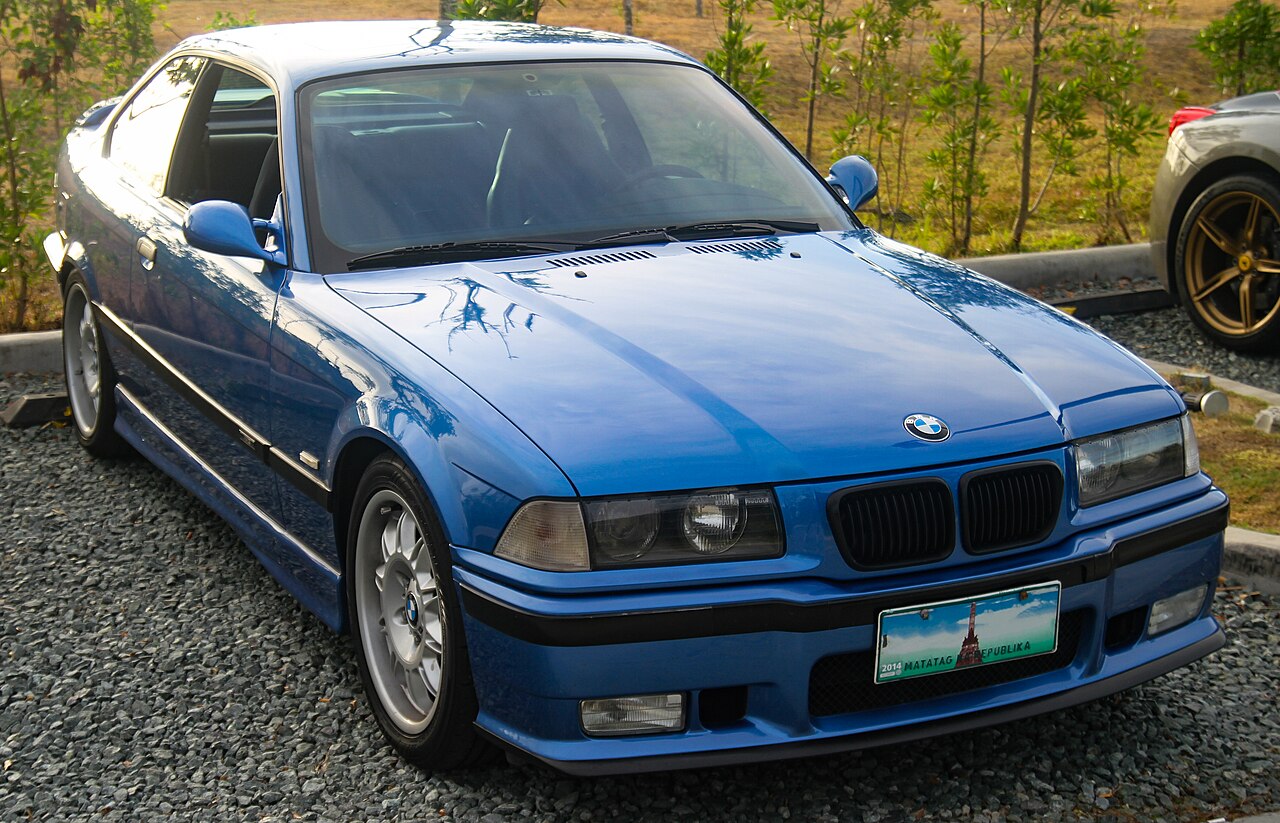
The E36 M3 went on sale in Europe in 1992 but was not sold in the United States until 1995.1 BMW developed the US version because the European M3's engine could not meet US emissions rules. According to BMW Group Classic, the US coupe was built from November 1993 to April 1999 with a 2,990 cc six through January 1996 and a 3,152 cc six after, rated at 243 PS (240 hp), and US-market production was 21,887 cars, including 126 limited-edition M3 Lightweights.2
| US M3 | European M3 | |
|---|---|---|
| Early engine | 3.0 L S50B30US, 240 hp, about 225 lb-ft (305 N·m) | S50B30, 286 PS |
| Later engine | 3.2 L S52B32, 240 hp, about 236 lb-ft (320 N·m) | 3.2 L S50B32, 321 PS |
| Manual gearbox | 5-speed throughout | 5-speed, then 6-speed from the 1995-96 facelift |
| Brakes | single-piece discs | floating-disc design |
Sources: Wikipedia, BMW Group Classic, Autocar.123
Wikipedia adds that US cars could be ordered with a ZF 5-speed automatic and that the changes were made to hold the price down, as US dealers feared a European-spec car would not sell.1 The US never got the six-speed manual that Europe received after its facelift.3 Autocar's summary is blunt: the US car is generally regarded as the lesser M3, with about 50 bhp less than the European car.3 Opinions differ on whether a US car or a gray-market European one is the better E36 M3 to own, so decide what you value (power, ease of registering and insuring, parts availability) before you shop.
When did the 3.0 become the 3.2?
This is the point where sources disagree, so verify it on the car itself.
- BMW Group Classic says the 3,152 cc engine arrived after January 1996.2
- Wikipedia's US section says the engine was upgraded to the 3.2 S52B32 in November 1996, with torque rising from 305 N·m to 320 N·m and power unchanged at 240 hp.1
- Autocar and CarBuzz both describe the switch as happening in 1996, with the 3.2 giving a modest torque increase and no extra power.34
- An enthusiast VIN guide says VIN positions 4 to 7 read "BF93" on a US 3.0 coupe and "BG93" on a US 3.2 coupe.5
So a 1995 car is a 3.0 (S50B30US) for sure, and a 1996 car could be either depending on build date. Do not rely on the model-year label alone. Check the VIN pattern and the engine code with a BMW dealer or specialist, and read the engine number on the block. The enthusiast guide also notes that the tenth VIN character is a year code (S for 1995, T for 1996, V for 1997).5
How to tell a genuine US M3
The E36 chassis is among the most cloned M3 bodies, and an ordinary 325i or 328i can be dressed up with M3 bumpers and wheels.5 To check:
- VIN. The first three characters should be WBS, and the model code (positions 4 to 7) should be consistent with an M3 coupe. The same VIN should appear on the dashboard, door-jamb label and registration.5
- Engine. Confirm that the engine is an S50B30US or S52B32 and not a swapped M50 or M52. A BMW dealer or independent specialist can confirm the VIN against build data.
- Specifics. US M3s had a conventional intake system and brakes without floating discs, and no oil temperature gauge, according to CarBuzz, a general automotive site.4
- Documents. Ask for service records and receipts, and the window sticker or a dealer-pulled build record for original colour and options. BMW Group Classic also issues a digital Birth Certificate for cars built since 1980, listing chassis and engine numbers, production and delivery dates and optional equipment; it records how the car left the factory but is not itself proof that today's car is unaltered.6
The cooling system
Multiple buyer's guides single this out. The BMW Blog guide advises asking whether and when the water pump and thermostat were replaced, with documentation, checking the radiator, hoses and plastic overflow bottle for leaks, and having the viscous fan clutch assessed by a technician.7 Keep hands and tools clear of a running fan. Autocar's expert notes that water pump bearings often fail, though the unit is easily replaced.3 A leaking heater core, signalled by a coolant smell or damp passenger-side carpet with the heat on, is costly to fix because of its location.7 NHTSA lists a 1998 BMW campaign (98V178000) on overheating in which dealers fitted a new-design radiator cap; whether it applies to a given car depends on VIN.8 Overheating can destroy these engines, so cooling-system work is not a place to cut corners.
VANOS
Listen for a distinctive rattle (the guide describes it as "metal marbles being shaken violently in a can") and inspect the rubber oil-supply hose to the VANOS unit for cracks or dry rot, which is a cheap preventive replacement.7 Autocar lists a loud rattle, a lumpy idle and a loss of low-end power as the warning signs.3
Rust and structure
The rear quarter panels and jacking points are vulnerable and the damage can be deeper than it looks.7 Autocar adds the front wings, boot floor and rear suspension mounts, and says a missing roundel on the windscreen suggests the glass has been replaced, so look for a poor seal that lets water corrode the bulkhead. The BMW Blog guide recommends avoiding cars beyond about 150,000 miles unless cheap, because chassis wear (rear shock towers, front strut towers and rear trailing arms) and bushings add up.73 Autocar also lists weak rear damper mounts, corroded brake pipes (which are costly to replace because the exhaust and fuel tank must be removed), seized calipers, cracking exhausts, failing fuel pumps and leaking air-conditioning condensers.3
Recalls
NHTSA lists campaigns against E36-era M3s, among them a throttle and cruise-control cable bushing campaign (97V131000) and side airbag control module reprogramming (99V063001). These apply to certain VINs only, so check the car through NHTSA and a BMW dealer.89
How "original" is original?
- Ask for service records and receipts.
- Look for signs of modification: aftermarket parts, repainted panels (Autocar warns that mismatched panel shades indicate past accident damage), non-original wheels and interior.
- Check the build sheet or window-sticker equivalent for original colour and options. A colour like Daytona Violet is a factory colour, so a car in that colour should be checked against its documented original paint code.
- The BMW Blog guide recommends unmolested examples with original or OEM parts in running condition and consistent preventive maintenance.7
- The M3 Lightweight is a special case: 126 were built per BMW, all in Alpine White, with a stripped specification (no air conditioning, radio or sunroof, and aluminium door skins), so be wary of any car claimed to be one without documentation.21
Questions behind an "original 1995 M3" listing
Ask the seller what "original" means before arranging a viewing. It could mean an original engine and paint, a car returned to standard after modifications, or simply factory-looking bodywork. Request separate answers for paint, drivetrain, interior, suspension and electronics, supported by the build record and receipts.
For a first-year US coupe, useful photographs include the door-jamb build label, VIN, engine identification, both front seats, wheel markings and the spare-wheel well. If a particular seat style or colour is essential, compare it with that car's factory option list rather than assuming every early M3 had it. Seat covers, complete seats and steering wheels are replaceable.
Are reversible modifications a reason to walk away?
They are a reason to ask more questions. Original parts supplied with the car, installation receipts and a clear account of its use make an exhaust or suspension change easier to assess. A missing history is harder to resolve than a visible modification. Ask whether the original ECU software, emissions equipment and ride height were restored if the advert says the car was "returned to stock".
US and European E36 M3 listings should be compared separately because the engines and later manual transmissions differ. The manual 3 Series Sport-package guide also helps identify a non-M3 dressed with sporty options.
Video demonstrations
The BMW M3 (E36) film
Sources and further reading
- BMW M3, Wikipedia
- BMW M3 Coupe (E36), US model, BMW Group Classic
- Used car buying guide: BMW M3 E36 (1992-1999), Autocar
- The story of the iconic BMW M3 built just for America, CarBuzz: a general automotive site; treat the detail as secondary.
- How to verify and decode a BMW E36 M3 VIN, BIMMERtips: an enthusiast resource.
- New birth cert for BMW classics, Autobiz: news report on the BMW Classic Birth Certificate (introduced April 2024).
- Buyer's guide: a look at the BMW E36 M3, BMW Blog
- NHTSA recall data, 1995 BMW M3: the 1996 to 1999 queries list the others.
- NHTSA recall lookup by VIN