BMW E30 M3: specs, versions and how to avoid a replica
The E30 M3 is one of the most copied BMWs, because ordinary E30 coupes are cheap and body kits are easy to find. If you are hunting for a genuine one, your main problem is proving it is real and not simply expensive. This guide covers what separates the versions, how to check a car, and what typically needs attention.

In this guide
What it is
The E30 M3 was built from March 1986 to June 1991, with 17,970 produced across coupe and convertible variants. It was a homologation special for touring-car racing and was shown at the 1985 Frankfurt show.1
| E30 M3 | |
|---|---|
| Engine | S14 four-cylinder, DOHC, four valves per cylinder, 7,250 rpm redline, individual throttle bodies, Bosch Motronic |
| Power | 195 PS (catalyst) to 200 PS, depending on market; US-specification cars were rated at 192 hp |
| Transmission | Getrag 265 5-speed manual: dogleg with close ratios on European cars, conventional pattern with an overdriven fifth on North American cars |
| Differential | clutch-type limited-slip, standard |
Sources: Wikipedia, Hagerty UK.12
What separates the versions
Wikipedia's production table lists these main variants.1
- Standard European coupe: 200 PS, 4,181 cars; the catalyst version at 195 PS, 4,591 cars.
- Evolution I (1987): a revised cylinder head marked with an "E" stamp; power unchanged; 505 cars built March to May 1987.
- Evolution II (1988): revised camshaft, pistons and compression ratio (10.5 to 11.0:1), deeper front air dam and a spoiler with a trailing flap, thinner side and rear glass, final drive 3.15:1 instead of 3.25:1; 162 kW (220 PS) at 6,750 rpm; 501 cars.
- Cecotto and Ravaglia editions (1989): 215 PS with catalyst; 480 Cecotto cars plus 80 de-tuned for Switzerland, and 25 Ravaglia cars.
- Sport Evolution (1990): a 2,467 cc engine rated at 238 PS at 7,000 rpm, an adjustable front splitter and rear wing, and brake-cooling ducts in place of fog lights; 600 cars.
- US-specification coupe: 192 hp; about 5,300 cars. NHTSA's recall database lists the E30-era US M3 under model years 1988 to 1991.13
- Convertibles: 786 across all variants, according to Wikipedia's table.1
Hagerty adds the 1989 Europameister edition (148 cars in Macau Blue per its summary) and notes that the E30 M3 was never built in right-hand drive by the factory; roughly 25 officially converted cars are mentioned, so be sceptical of any RHD claim.2 The 2.3-litre S14 makes modest torque (177 lb-ft at 4,750 rpm per Hagerty), so it is a car that wants revs.
Is it a real M3?
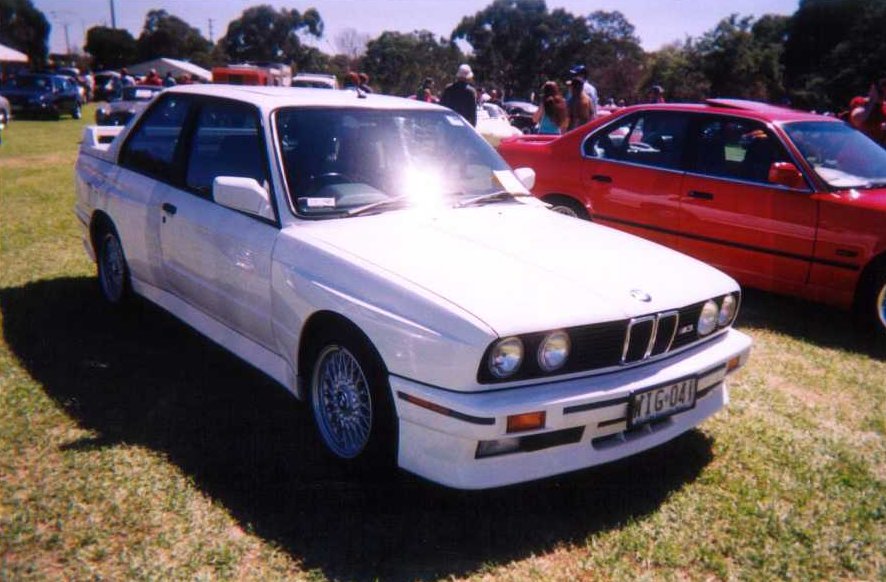
The E30 M3 shares very few panels with an ordinary E30. The sources disagree on exactly which: Wikipedia says only the hood, roof panel and sunroof are common, while Hagerty says the hood and doors.12 Either way, a genuine M3 differs in many ways a body kit does not reproduce:
- Body. The flared ("blistered") wheel arches, the shallower rear window and its thicker rear pillars, the raised glass-reinforced-plastic trunk lid, the glued-in windscreen (the M3 does not use a rubber surround), and unique bumpers and sill panels.12
- Hubs and brakes. A five-stud hub pattern (ordinary E30s use four studs), 280 mm vented front discs and 282 mm solid rear discs, with calipers and master cylinder specific to the M3.12
- Engine. The S14 is unique to the car; a standard E30 with an M3 body kit and an M20 or M42 engine is not an M3.
- VIN and stampings. BMW VINs follow a standard format, and a genuine car's identity should agree between the dashboard plate, door-jamb label and body stampings. A buyer's-guide compilation advises checking the VIN stamps on several panels, looking for mismatched stampings on doors, fenders and hood, and for evidence that panels have been replaced.4 Wikipedia's production table lists BMW type codes AK01, AK03, AK05 and AK07 for coupes and BB01 and BB05 for convertibles; have a specialist confirm how they should appear for the car in front of you.1
- Factory records. BMW Group Classic offers a digital "Birth Certificate" for cars built since 1980, showing chassis and engine numbers, production and delivery dates and optional equipment, issued with proof of ownership and photographs of the chassis and engine numbers. Press coverage points out that it records how the car left the factory and does not by itself guarantee that today's car is genuine, so compare it with the physical car.5
- Paper trail. Ask for the original title or registration history, service records and any club documentation.
Because the whole body shell is bespoke, a replica built on a standard shell is detectable to someone who knows what to look for, so have an E30 M3 specialist inspect the car before you pay.2
Which version suits what?
- Most usable and most numerous: the standard European 200 PS or the catalyst car; the US 192 hp car is the easiest to register in North America and has the conventional shift pattern.
- Collectable: Evolution II, Sport Evolution and the numbered special editions, whose small production runs make documentation essential.
- Open-top: convertibles are rare (786 per Wikipedia) and have their own body-stiffness and hood-mechanism checks.
The S14 engine
Compiled buyer's guides stress that you should budget for specialist inspection of the engine. Points raised include timing-chain replacement on cars past about 100,000 miles (Hagerty suggests that, because few cars cover such mileage, the job should be done roughly every five years), oil leaks from the sump, split rubber intake gaskets, valve clearances that cause a rough idle, and doing compression and leak-down tests before buying.42 The same sources advise full warm-up before working the engine hard (the compilation suggests about 160 F before going above 4,000 rpm) and checking the oil level regularly; the compilation also warns that a very low-use car may suffer from degraded seals. Expect the gearbox to be stiff and slow when cold, and check the differential and gearbox for leaks.2
Rust and structure
The buyer's-guide compilation lists rust at the rear pop-out windows on 1988-89 cars, the bottom of the trunk pan, around the windscreen rubber, sunroof surrounds, and sheet metal behind the front shock towers; it also warns about subframe cracks and signs of accident repair.4 Hagerty tells buyers to lift the carpets and check the whole floor, the suspension turrets and chassis legs, inner wheelarch edges, door bottoms and all seams, to look for fresh paint hiding corrosion, and notes that a cracked fuse-box cover may suggest hard track use.2
Running gear
Expect to replace suspension bushes unless recently done, and check rear shock mounts and front tie-rod ends (worn ones cause judder under braking). Hagerty calls the handbrake a known weak point; test it on a hill. Brake work, suspension repairs and fuel-system work should be done by a qualified professional.2
Recalls
NHTSA lists campaign 93V015000 (February 1993) against 1988 to 1991 M3s: a coolant-system malfunction can raise coolant temperature and pressure in the heater core, and dealers installed a thermostatic bypass valve. Check whether the car has had it.36
Budgeting
Cheap examples tend to hide deferred maintenance, and the guides advise paying for an independent specialist inspection (an S14 specialist, not the seller's preferred shop) instead of trusting the seller's description.4 Check current sales and club listings for realistic figures, and ask any seller for a full record of engine and structural work.
A photo checklist for a distant E30 M3
The rear-window shape, wheelarches and boot area are more useful than a flattering front photograph when comparing an M3 with a body-kit car. Request straight-on rear and side views, close-ups of the rear pillars and windscreen installation, photographs of the engine bay, and unobstructed views of the VIN stampings. These images help decide whether to commission an inspection; they cannot authenticate the shell by themselves.
For an Evolution or numbered edition, ask the seller to separate factory equipment from later additions. A wing, splitter, badge or set of seats can be replaced. The production record should explain the claimed variant, while invoices should explain anything changed since delivery. BMW's own E30 M3 history provides a useful visual reference for the standard car and Sport Evolution.
What should an engine-rebuild invoice show?
"Rebuilt S14" is too broad to compare two cars. Request the date and mileage, the workshop, the diagnosis that prompted the work, the parts replaced and any machine-shop measurements or post-rebuild checks. Ask what running-in and follow-up servicing were performed. A cosmetic engine-bay refresh and a documented internal rebuild should not be treated as equivalent.
Decide whether the goal is a period-correct collection car or a usable driver before excluding every changed component. Wear-item replacement can be sensible; unexplained changes to the car's identity are a separate concern.
Video demonstrations
Inside BMW Group Classic: The BMW M3 E30
Sources and further reading
- BMW M3, Wikipedia
- Buyer's guide: BMW M3 (E30, 1986-1992), Hagerty UK
- NHTSA recall data, 1988 BMW M3: campaign 93V015000 also appears for 1989 to 1991.
- E30 M3 buying guide collection from forums, magazines and specialists, Strikeengine: a compilation of third-party guides.
- New birth cert for BMW classics, Autobiz: news report on the BMW Classic Birth Certificate (introduced April 2024).
- NHTSA recall lookup by VIN