C6 Corvette Z06: 2009 vs 2010, the LS7 valve-guide issue and buying a built car
The C6 Z06 (2006-2013) is a 7.0-litre, naturally aspirated, manual-only Corvette. Buyers comparing a 2009 with a 2010 are usually asking one question underneath: "is one of them less likely to have engine trouble?" This guide separates what is documented from what is rumour, and covers the other things worth checking on a car that has been driven hard.

In this guide
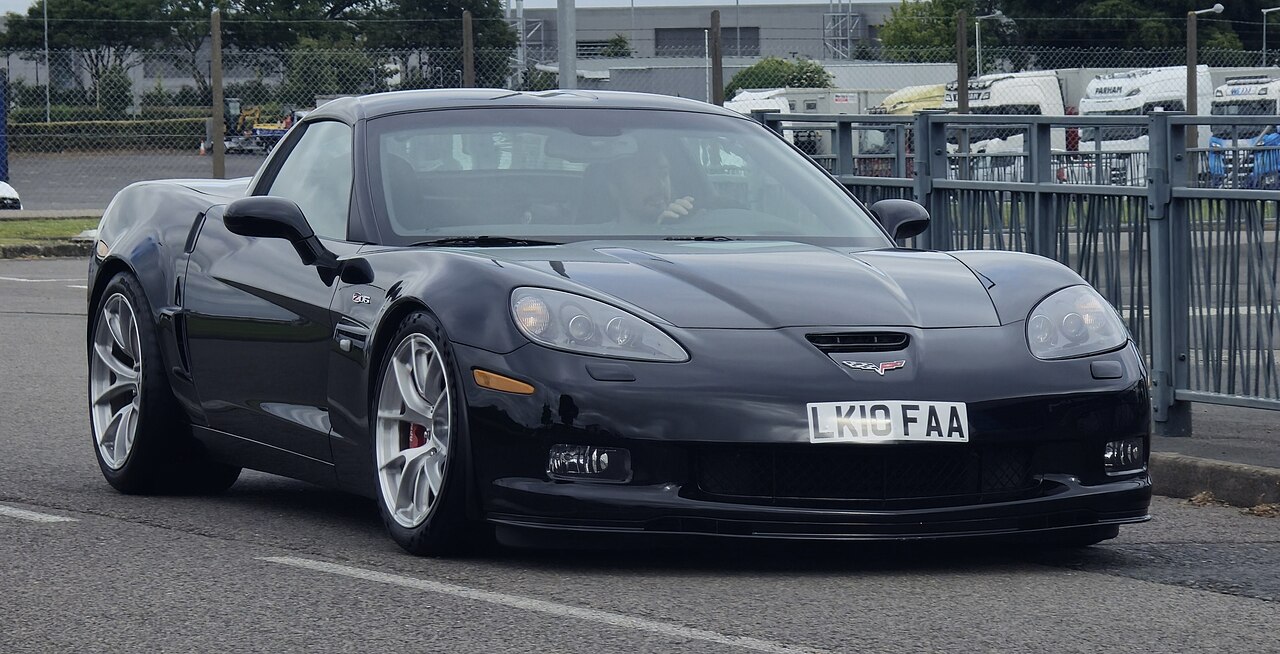
What the Z06 is
| C6 Z06 | |
|---|---|
| Engine | 7.0 L (7,011 cc) LS7 V8, dry-sump oiling, titanium connecting rods |
| Power / torque | 505 hp at 6,300 rpm / 470 lb-ft at 4,800 rpm |
| Weight | about 3,130 lb (1,420 kg) as quoted by the National Corvette Museum; Car and Driver recorded 3,147 lb |
| Transmission | 6-speed manual: Tremec T56 through 2007, TR6060 from 2008 |
| Brakes | cross-drilled 355 mm front and 340 mm rear rotors |
| Body | aluminium frame, carbon-fibre front fenders, wider rear bodywork with brake-cooling ducts |
Source: Wikipedia.1
The Z06 arrived in the third quarter of 2005 as a 2006 model and was the lightest Corvette of its generation. The 2008 model year brought the TR6060 gearbox to the Corvette range; an owner-oriented article on CorvetteForum describes later cars as having a stronger gearbox and axles than the earliest ones and says early rear axle shafts could fail under extreme use (owner opinion, not a GM statement).2
What changed between years
Model-year changes between 2009 and 2010 are modest. In 2009 the ZR1 joined the range and the Z06 got new "Spyder" wheels; in 2010 the Grand Sport arrived and launch control became standard with the manual transmission.1 Later special content on the Z06 includes:
- 2007 Ron Fellows Championship Edition: 399 built, 33 of them for Canada.1
- 2011 Z06 Carbon Limited Edition: ZR1 carbon-ceramic brakes, Magnetic Selective Ride Control and carbon-fibre pieces; Chevrolet planned 500 but about 252 were built, in Inferno Orange or Supersonic Blue only.1
- 2012-2013 Z07 package: made the carbon-ceramic and suspension content available as an option on the regular Z06.1
There is no major mechanical redesign of the Z06 between 2009 and 2010, so the choice comes down to condition, options and history.
The LS7 valve-guide issue
The best-documented concern about the LS7 is premature valve-guide wear.
- The mechanism. The Corvette Action Center's technical series attributes it to a lack of concentricity between valve guides and valve seats on heads machined by a supplier (it names Linamar), which loads the valve stems sideways and wears the guides faster. The same series says the guides are powdered metal, and reports a seat runout of 0.0025 in on one examined head against a 0.002 in production maximum.3
- Symptoms. Early wear can be silent. As it progresses you may hear more valvetrain noise, then see higher oil consumption, a misfire and an illuminated check-engine light; in the worst case, high-rpm operation with badly worn guides can lead to catastrophic failure.3
- How it is measured. The only reliable measurement is stem-to-guide clearance with the head off the engine; the Action Center cites a GM service limit of 0.0037 in.3 GM's own bulletin 13-06-01-001 (January 2013, revised as 13-06-01-001A in June 2015 for all 2006-2013 Corvette Z06 and 427 cars and the 2014 Camaro Z/28) describes the procedure: measure the valve stem with a micrometer, measure the guide inside diameter with a ball-type gauge, subtract, and replace the valve or head if clearance is out of specification.4 The same bulletin tells dealers that if a car has no unusual noise or driveability fault there is nothing to indicate the engine needs disassembly, that an inspection requested only because of internet reports is at the customer's expense, and that GM would cover inspection and repair under the powertrain warranty if wear beyond the service limit is found.4
- What GM did. The Action Center reports warranty replacement of heads and in some cases complete engines without formal acknowledgement of a design problem, and says GM would not supply powdered-metal guides as separate parts. Out-of-warranty owners therefore usually have heads reworked with aftermarket guides by a machine shop.5 A shop experienced with LS7 heads is essential; this is precision work.
- The lawsuit. A proposed class action by C6 Z06 owners over the valve guides was filed in October 2015, according to the Action Center.3 The later appeal, Adams et al. v. General Motors LLC, ended when the Ninth Circuit upheld summary judgment for GM because the plaintiffs had not produced admissible evidence that their own cars contained the alleged defect; their expert declarations had been filed after the deadline. GM Authority reported the dismissal on 14 January 2022.67 That outcome is not a finding on whether the defect exists.
Which cars are in the suspect window? According to the Action Center, GM first said the problem affected "some 2008-2011" Z06 cars, and said in 2012 that the supplier issue was contained, with 100% inspection of heads from February 2011. In March 2015, GM Powertrain revised the suspect period to July 2008 through March 2009, citing guides with excessive inside diameter. The same page says it found evidence in 2014 of heads assembled after GM's fix date with premature guide wear, that replacement warranty heads may also have problems, and that GM provides no VIN ranges.5 The window straddles model years, so a 2009 car built late in the window and a 2008 car built from July 2008 are both inside it. A CorvetteForum article argues wear can affect any LS7 of any year (owner opinion).2 The practical reading: cars built in the window deserve the most scrutiny, but no year is guaranteed safe.
What to do before buying
- Read the build date on the driver's door jamb label and place the car relative to the window.
- Ask for service and warranty history. Were heads or an engine replaced, when, by whom, and with what guide material?
- Listen to a fully warm engine for valvetrain noise and ask about oil consumption between changes.
- Have an LS7-experienced shop inspect it. A noisy valvetrain is a reason to measure clearance, not to guess.
- Remember that repair involves pulling the heads; get written estimates rather than assuming.
Other checks on a Z06
- Roof panel. NHTSA campaign 09V491000 covers certain 2005-2007 Corvettes with removable roofs and 2006-2007 Z06 cars, where the adhesive between roof panel and frame can separate; the remedy was a new-design roof panel. Check that the work was done and look for snapping noises or panel movement.8
- Headlamp circuit. Campaign 14V251000 (2005-2007 cars built to June 2007) concerns a bussed electrical centre housing that can expand and fracture the low-beam relay wire; the remedy is a jumper wire.8
- Recall search. NHTSA's database shows no campaigns against 2008 to 2010 or 2013 Corvettes under this query, and one 2011-2012 coupe campaign (11V491000) for rear hatch hinges; still, run the VIN yourself because coverage changes.89
- Driveline and hard use. Look for signs of track use: worn tyres in odd patterns, heavily used brakes and clutch, aftermarket tunes. Ask when the brake and clutch hydraulic fluid was last changed.
- Safety. Brake, suspension and driveline repairs should be done by a qualified professional.
Buying a modified or "built" twin-turbo Z06
Some cars come with forged internals and twin turbos at 800+ rear-wheel horsepower. That changes the risk profile in ways you must evaluate yourself:
- Documentation. Ask for the builder's name, the parts list, the tuner and dyno sheets, and whether the heads were reworked. A car that has had its guides replaced as part of a build may be less of a gamble than a stock-head car.
- Factory coverage. Assume any remaining factory coverage is void on heavily modified engines; GM's bulletin itself ties coverage to the powertrain warranty.4
- Support. A car this heavily modified is only as good as the shop that built and tuned it. Be sure that shop still exists and will talk to you.
- Whole-car upgrades. Check whether the driveline (axles, clutch, differential cooling) and fuel system were upgraded to match the power, not just the engine.
- Base condition. The valve-guide caveat applies to the donor heads unless they were replaced.
Choosing between 2009 and 2010
The one place where the year genuinely matters is the valve-guide window: a 2009 car built before April 2009 falls in GM's revised suspect period, while a 2010 car does not, although the Action Center's report of later problem heads means that is not a guarantee. Beyond that, a 2010 gives you launch control as standard; otherwise pick on condition and history. A car with documented head or engine work is a better bet than an unknown-history car with one fewer year on it.
Comparing a stock Z06 with a forged-engine build
Keep two shortlists: standard or lightly modified cars, and complete turbo builds. The second requires a build dossier rather than a longer list of brand names. Request invoices identifying the engine builder, machine shop, pistons, rods, heads, camshaft, fuel system, turbo hardware and tuner. Ask whether the original LS7 block remains and whether the current calibration matches the parts fitted now.
A dyno plot needs context: date, fuel, boost setting, correction method and whether it is wheel or engine output. Peak horsepower does not show how the car behaves in traffic, starts cold or handles heat. Ask the tuner to explain the intended fuel, service requirements and safeguards, and arrange a road-use inspection appropriate to the car's legal registration.
What does "heads done" actually establish?
Request the head-work invoice and ask which measurements, guides, valves and machining operations it records. A phrase in an advert cannot establish clearance or workmanship. Equally, a compression result is not a substitute for the guide-clearance procedure described in GM's bulletin.
For a 2009-versus-2010 comparison, record build date, mileage, head-work history, clutch history and inspection findings in the same columns. That prevents a later model-year badge from outweighing a better-documented earlier car. Check the actual brake and suspension equipment when a seller describes a car as Carbon or Z07 specification.
Sources and further reading
- Chevrolet Corvette (C6), Wikipedia
- Examine that LS7 before purchasing a C6 Z06, CorvetteForum: owner-community article, opinion rather than GM statement.
- Ruthless Pursuit of Power: the mystique of the C6 Corvette LS7 engine, Corvette Action Center (a 26-page technical series; the valve-guide pages are the relevant ones).
- GM Information Service Bulletin 13-06-01-001A, June 2015, NHTSA TSB archive (PDF): valve guide wear and measuring procedure.
- LS7 valve-guide issues, Corvette Action Center (page 21 of the LS7 series): GM's stated suspect period, parts policy and heads built after the fix.
- Corvette Z06 engine failure lawsuit dismissed, GM Authority
- Ninth Circuit nixes proposed class action lawsuit against GM for defective C6 Z06 engine valve guides, Corvette Blogger
- NHTSA recall data, 2006 Chevrolet Corvette: campaigns 09V491000 and 14V251000; 2011 data lists 11V491000.
- NHTSA recall lookup by VIN