Honda Civic EG vs EK: choosing a clean 1992-2000 hatch or coupe
Buyers who want a "clean EG or EK" are choosing between two generations of Civic that look similar in the classifieds but differ in trims, engines and how much of the car is likely to be original. Almost every one of these cars is now over 25 years old, so condition, modification history and paperwork matter more than the badge.
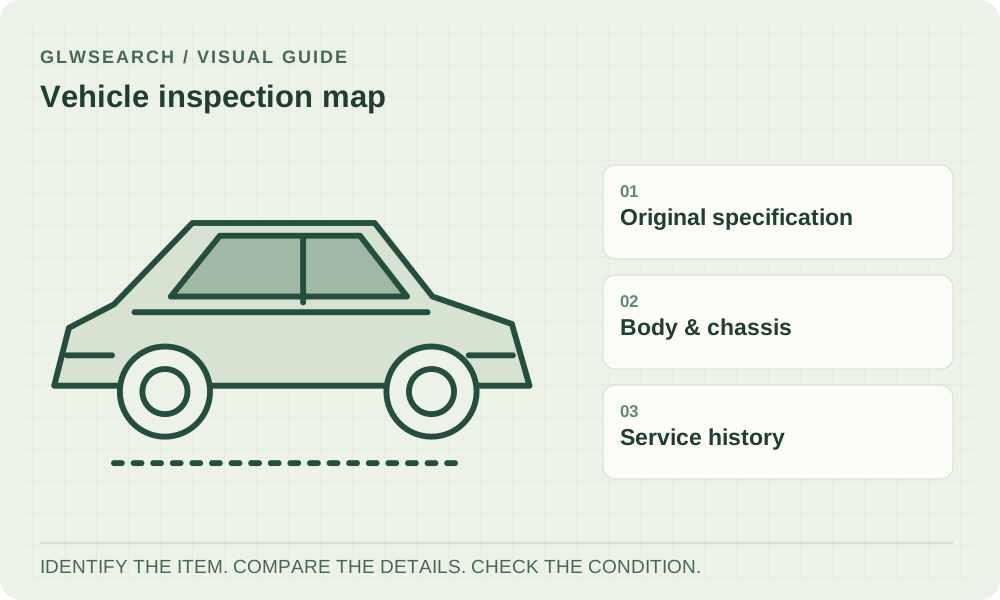
In this guide
Which is which
The EG is the fifth-generation Civic sold in the US from 1992 to 1995; the EK is the sixth generation, sold from 1996 to 2000. Wikipedia describes the EK as the last Civic generation with front double-wishbone suspension, and notes a 1999 refresh with new grille, headlights, bumpers and interior changes.1
US trims and engines
Fifth generation (EG), US market, as listed by Wikipedia:2
| Trim | Engine | Output |
|---|---|---|
| CX hatchback | D15B8 1.5 L, 8-valve | 70 hp |
| DX / LX | D15B7 1.5 L, 16-valve | 102 hp |
| VX hatchback | D15Z1 1.5 L VTEC-E | 92 hp |
| Si and EX | D16Z6 1.6 L SOHC VTEC | 125 hp |
Body styles were three-door hatchback, two-door coupe and four-door sedan. In the US, the 1992-1995 Si was a hatchback; Honda identifies the 1999 model as the first Si coupe.3 The EX coupe and a one-year EX-S coupe (1993) are also listed.2
Sixth generation (EK), US market:1
| Trim | Engine | Output |
|---|---|---|
| CX / DX / VP / LX | D16Y7 1.6 L SOHC | 106 hp |
| HX | D16Y5 VTEC-E lean burn | 115 hp |
| EX | D16Y8 SOHC VTEC | 127 hp |
| Si (1999-2000) | B16A2 DOHC VTEC | 160 hp |
Wikipedia says the EK Si was offered only as a coupe from 1999.1 That has a practical consequence: an EK hatchback advertised with a B16A2 is very likely an engine swap rather than a factory US car. Likewise an EG hatch described as "B16" may be a swap or a Japanese-market import; the Japanese EG6 Si used a B16A, and Japanese cars became legal to import after 25 years.4
Which to choose
- EG hatch: lighter, more compact and the usual starting point for builds. Si cars are the most sought-after, and most surviving examples have been modified at some point.
- EK: newer, and the last Civic with front double-wishbone suspension. The only factory performance car in the US is the 1999-2000 Si coupe, so if you want a factory Si, plan on a coupe.
- Non-Si cars: the base trims share the same chassis and are the cheaper way into a stock, unmodified example.
What to check
Rust. A marketplace buying guide for the Integra and Civic family names rear quarters, sills, floors, strut towers, spare-wheel well and subframes as the usual rust areas; treat that as one vendor's view, but those are sensible places to look on any car of this age.5 Repairs to structural rust can cost more than the car is worth, so a rust-free shell is the first priority.
Engine provenance. Many cars have had swaps, some with improvised mounts and wiring.4 Check the engine code stamped on the block against the trim, read the VIN against the title, and look for cut or spliced wiring under the dash and in the engine bay.
Maintenance. Ask for evidence of timing-belt replacement, valve-cover and cam-seal leaks, and the condition of the transmission synchros, particularly on cars driven hard.
Aftermarket parts. Aftermarket headlight and corner-lamp sets for these cars have been the subject of many NHTSA recalls for missing amber reflectors, so cheap replacement lighting is worth a second look.6
Theft history and title
Older Hondas have long been theft targets. NICB's 2010 report ranked the 1995 Civic second on its most-stolen list, and NICB attributed older vehicles' prominence to weak security systems and parts value.7 For a buyer, that means:
- Run the VIN through a history report and check for salvage or rebuilt branding.
- Verify the VIN plates on the dash, door jamb and (where fitted) body panels match, and look for signs of altered or re-glued labels.
- Be cautious with cars with a missing or unusually thin history, wiring that has been replaced, or a steering column that has been damaged and repaired.
Safety and recalls
Enter the VIN at NHTSA to check open recalls.8 For example, NHTSA lists a January 2020 driver-side airbag inflator recall (20V026000) among the 1996 Civic recalls.9 If a recall applies, have it done by a dealer before you rely on the car. Brakes, suspension bushings and tires on a car that has sat unused should be inspected by a qualified mechanic.
What "clean EG" or "clean EK" should mean
A clean search result should describe the shell, title and mechanical configuration separately. A shiny modified Civic with a respray is a different proposition from a preserved factory car, and neither description proves that the underside is sound. Ask for clear photographs of both rear wheelarches, sill seams, jacking points, floor, spare-wheel well and engine-bay wiring before arranging a viewing.
Treat EG and EK as broad search labels, then confirm the exact chassis identification, body style and original market from the car's documents. A seller may apply the familiar label to an entire generation. For a factory US Si, verify the model year and body: Honda's history identifies the 1992-1995 Si as a hatchback and the 1999 model as the first Si coupe.3
How should a swapped Civic be compared?
Ask for the engine and gearbox codes, ECU details, donor information and installation invoices. Confirm which brake and suspension changes accompany the conversion and whether emissions equipment is present. Registration and insurance requirements need checking for the buyer's location, especially when the car combines parts from different markets.
Stock trim pieces supplied with the car and a documented modification history are useful, but they do not replace a shell inspection. The Integra DA and DC guide covers the parallel search when condition matters more than choosing between a Civic and an Integra.
Sources and further reading
- Honda Civic (sixth generation), Wikipedia
- Honda Civic (fifth generation), Wikipedia
- Honda Civic Si Timeline and Milestones, Honda Newsroom: US Si body styles and model chronology.
- Honda Civic EG6 buyer's guide, JDMBUYSELL: marketplace site; covers JDM cars and swaps.
- Honda Integra buyer's guide, JDMBUYSELL: marketplace site; general rust list.
- NHTSA recalls by vehicle, 1993 Honda Civic, National Highway Traffic Safety Administration.
- Older Vehicles Top the List of NICB's 10 Most Stolen Vehicles for 2010, Auto Remarketing
- NHTSA recalls lookup, National Highway Traffic Safety Administration
- NHTSA recalls by vehicle, 1996 Honda Civic, National Highway Traffic Safety Administration.