Porsche 911 (964): versions, specs and what to check
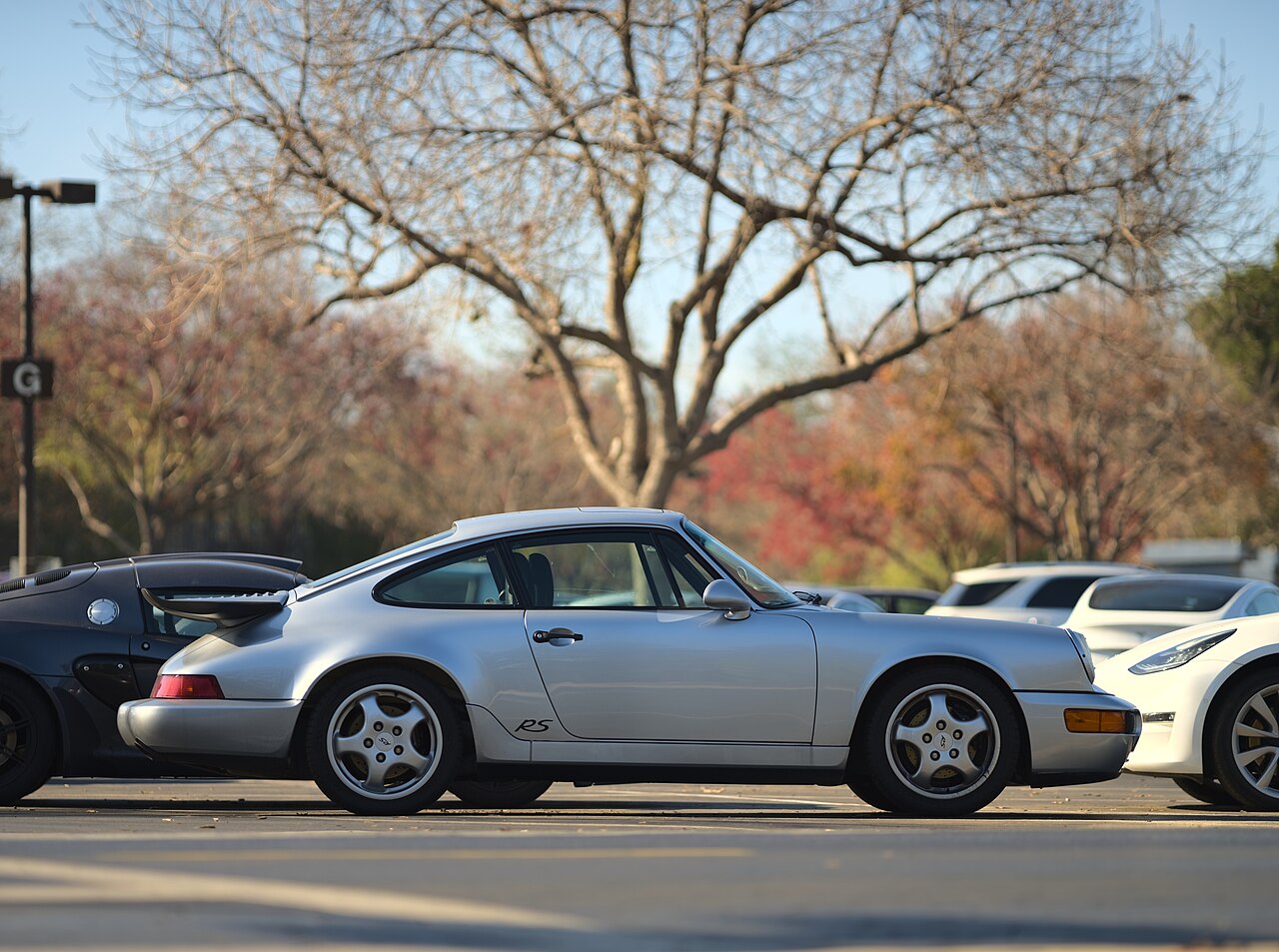
The 964-generation 911 is often described as the bridge between the classic air-cooled 911 and the modern car. If you are searching for one, your first task is deciding which 964 you want, because the range runs from a daily-usable Carrera to the rare Carrera RS, and the known problems depend heavily on the year.
_RS_America_in_Palo_Alto%2C_CA%2C_USA.jpg)
In this guide
How the range developed
Porsche says the new generation came to market for the 1989 model year as the all-wheel-drive Carrera 4, with the rear-drive Carrera 2 following in 1990 and a Turbo after that. Under a body that looked familiar apart from integrated bumpers, about 85 percent of the car was newly designed.12 Coupé, Targa and Cabriolet bodies were offered. Porsche's own tally of all variants is 63,762 cars.2
| Version | Engine | Power |
|---|---|---|
| Carrera 2 / Carrera 4 | 3.6 L naturally aspirated | 250 PS (247 hp) |
| Carrera RS (1992, Europe) | 3.6 L | 260 PS (256 hp) |
| Carrera RS 3.8 | 3.8 L | 300 PS (296 hp) |
| Turbo 3.3 | 3.3 L turbo | 320 PS (316 hp); Turbo S 381 PS |
| Turbo 3.6 (from 1993) | 3.6 L turbo | 360 PS (355 hp); Turbo S 385 PS |
Wikipedia gives these production figures: 3,660 Turbo 3.3 (from March 1990), 1,437 Turbo 3.6 (January 1993 onward), 2,282 Carrera RS 3.6 coupés, and 701 RS America cars in 1993-94. Special editions include the Jubilee (911 cars in 1993 marking 30 years of the 911, finished in Viola metallic with Rubicon Grey leather), the Speedster (936 in Wikipedia's count; Porsche says 930 on a Carrera 2 Cabriolet base) and the America Roadster (250). The Wikipedia table that lists production by body style does not add up exactly to Porsche's total, so treat per-model counts as approximate.32 Porsche Classic dates the first Turbo to the 1991 model year, while Wikipedia gives March 1990, so check the VIN-specific build date rather than relying on a model year label.13
What was new in the 964
- Tiptronic, power steering and ABS. The 964 was the first 911 offered with the Tiptronic automatic, and power steering and ABS became standard for the first time.32 A specialist guide notes that Tiptronic was only ever combined with rear-wheel drive, never with the Carrera 4's all-wheel drive.4
- Chassis. Coil springs and dampers replaced the torsion bars.3 An automatically extending rear spoiler reduces lift.2
- Ignition. Twin-spark ignition, which Porsche says it developed for greater reliability in aircraft engines, uses two plugs per cylinder.2
- Carrera 4. Electronically controlled all-wheel drive; Porsche Classic describes the normal torque split as 31 percent front and 69 percent rear.1
Carrera 2 or Carrera 4?
The "2" is rear-wheel drive, the "4" all-wheel drive. The Carrera 4 gives better grip in poor weather and is more forgiving; the Carrera 2 is lighter and simpler, is often preferred by purists, and is the only 964 with the Tiptronic option. Elferspot warns that servicing a Carrera 4 is more complex and costly because of the extra driveline in a cramped engine bay.4 Wikipedia's figures show more Carrera 2s were built, so there are more to choose from.
Known weak points and how to check them
Most of the 964's famous problems relate to the engine and ancillaries. Owner clubs and specialists describe the following.
- Oil leaks. The Porsche Club Great Britain 964 Register guide says early cars leaked from the cylinder-head bases, and that the design was changed during the 1991 model year (from engine number 62M06836); check service records for the retrofit on earlier cars.5 A PCA technical adviser says the most common sources are valve covers and chain housings, that O-rings at the case through-bolts can produce jets of oil at higher revs, and that the distributor belt is a related issue; he suggests warming the engine and watching underneath at 4,000 rpm on a lift.6 Some seepage is normal for any air-cooled engine; heavy leaks are not.
- Dual-mass flywheel. PCGB's guide says the dual-mass flywheel was introduced in 1990 and that early units caused vibration and shifting difficulty and that Porsche changed components in 1992.5 Rennlist owners say the 1990-1991 cars had problematic Freudenberg units, that 1989 cars had a single-mass flywheel, and that the LUK unit from 1992 has held up better; the same thread cautions that fitting a very light single-mass flywheel can cause stalling because of the engine software.7 Symptoms are vibration at low rpm and rattle; replacement means removing the gearbox.
- Twin-distributor belt. Each cylinder has two plugs and the two distributors are linked by a belt that PCGB says failed quickly because of ozone; Porsche offered a vent kit and the belt is a periodic replacement item.5 The PCA adviser also recommends replacing it on older engines.6
- Rear-heater blower resistor. PCGB's guide flags an overheating resistor as an engine-bay fire risk and says the newer version has overheat protection.5 NHTSA recall 93V204000 (December 1993) covers 1990-1992 cars for exactly this: a binding or seized rear heater blower can overload the resistor and ignite its plastic air pipe.8 Ask for evidence the update was done.
- Other maintenance. A US specialist's guide lists failing power-steering pumps and rack seals on aging cars, gearbox synchromesh wear (second gear), head-stud failures (less common than on earlier 911s), tired air conditioning and R134a conversions, and no-start trouble from the DME relay and gauge-cluster solder joints; it is a dealer guide, so read its advice as one view.9 Elferspot lists distributor belts, worn flywheels and release bearings on early cars, faded tail lights, shrinking dashboards and weak air conditioning.4
Recalls
NHTSA lists several campaigns on 1990-1992 911s, which cover the 964 generation: a front-hood latch campaign (91V012000), cruise-control linkage (92V142000), the rear-heater resistor (93V204000), a brake pressure reduction valve that could allow rear-wheel lock-up on 1991-1992 cars (93V205000), and a cracked steering-column universal joint (96V147000).8 Cars may have had these done long ago, but ask for proof and run the VIN with a Porsche Centre; market campaigns differ.
Body and rust
The 964 body is galvanised but not immune. PCGB lists windscreen surrounds, scuttle panels, sills beneath the plastic covers, wing-to-bumper junctions, bumper brackets, engine tin and rear-light enclosures as common rust areas, and rear arch mounts, jacking points, headlight bowls and floor sections as less common but serious. It also notes damp carpets from poor window seals and, on Targas, leaking roofs and cracked or shrunk vinyl.5 Elferspot adds corroded battery boxes and jack points, rust around the windows (often after poor glass replacement), and warns that dented front-luggage-compartment supports indicate prior impact.4 Cabriolet and Targa seals also crack with age.
Is the car original and correct?
For a car of this age, originality drives value. A Porsche Certificate of Authenticity lists original options, colour and production date, and in the US the Porsche Production Specifications serves a similar purpose without engine or gearbox serial numbers.1011 Porsche Classic's Technical Certificate covers the 964, documenting engine and gearbox numbers against factory records alongside an inspection.12
Be careful with "RS-look" cars: genuine Carrera RS models were a small, European-focused subset, with the Lightweight Clubsport (M003) listed at about 1,217 kg, so verify the VIN and paperwork.3 "Turbo-look" Carrera 2 Cabriolets were also built in numbers (1,532, per Wikipedia), which makes identification by the wide body alone unreliable.3 Engine rebuild invoices deserve scrutiny: PCGB notes that some rebuilds amount to little more than rings and gaskets.5
What next?
An inspection by an air-cooled specialist should cover the items above, plus leak-down testing and a check of oil pressure and temperature behaviour (PCGB quotes hot idle pressure of about 1.0-1.5 bar and 4-5 bar under throttle for a healthy engine).5 Brake and steering work are safety-critical and should be done by a qualified professional. Join an owners' club or a model-specific forum, and ask members who have owned the version you want what they would check first.
Reading a 964 restoration or engine-rebuild file
A restoration file is most useful when it links work to photographs and invoices. Ask for images before paint, during any structural repair and after assembly, plus the workshop names and dates. A finished underside photograph cannot show what was repaired beneath new coatings. For a colour change, request the original paint record and an account of how thoroughly the shell was stripped.
Engine invoices should say more than "rebuilt". Ask what prompted the work, which measurements and machining were performed, what components were replaced and how the finished engine was checked. A reseal, top-end repair and comprehensive rebuild are different jobs; mileage since completion and subsequent servicing also belong in the comparison.
How should an RS-look or backdated car be searched?
Keep factory variants and conversions in separate lists. Search terms such as "964 Carrera 2 manual", "964 Carrera 4" and "964 RS tribute" describe different starting points, and a wide body or stripped interior does not establish a genuine RS. A conversion can suit a driver, but its underlying identity and changes still need documenting.
Choose the body style before narrowing the colour: a Targa brings removable-roof fit and seal checks, while a Cabriolet needs hood-operation and water-ingress checks. For an air-cooled car, arrange the specialist inspection before committing to transport or relying on an auction description.
Sources and further reading
- Porsche 911 type 964, Porsche Classic: manufacturer model page.
- The type 964: a new start with this 911, Porsche Newsroom: manufacturer history.
- Porsche 964, Wikipedia: variants, outputs, production tables.
- Kaufberatung: der Porsche 964 Carrera, Elferspot: a Porsche marketplace's buying guide (German).
- 964 Buyers' Guide, Porsche Club Great Britain forum: compiled by members of the club's 964 Register; club member opinion.
- 1990 964 oil leak(s), Porsche Club of America Tech Q&A
- DMF issue and resolution, Rennlist forum: owner discussion; not an official statement.
- NHTSA recalls lookup and its recall API for Porsche 911, model years 1990-1992.
- Porsche 964 resources, ZRG Classics: a US dealer's guide; its cost figures are not used here.
- What is a Porsche Certificate of Authenticity?, Flatsixes: contents of the certificate; its ordering instructions are dated.
- Vehicle information, Porsche USA
- Porsche Classic Technical Certificate, Porsche USA