Buffalo nickels (1913–1938): types, key dates and the date-wear problem
Buffalo (or Indian Head) nickels are beloved and awkward to collect, mainly because the date sits on a raised spot that wears off first. That one design flaw shapes everything about buying them: what is cheap, what is hard to grade, and why so many coins are sold with a date "restored".
.jpg)
.jpg#Licensing)
In this guide
What they are
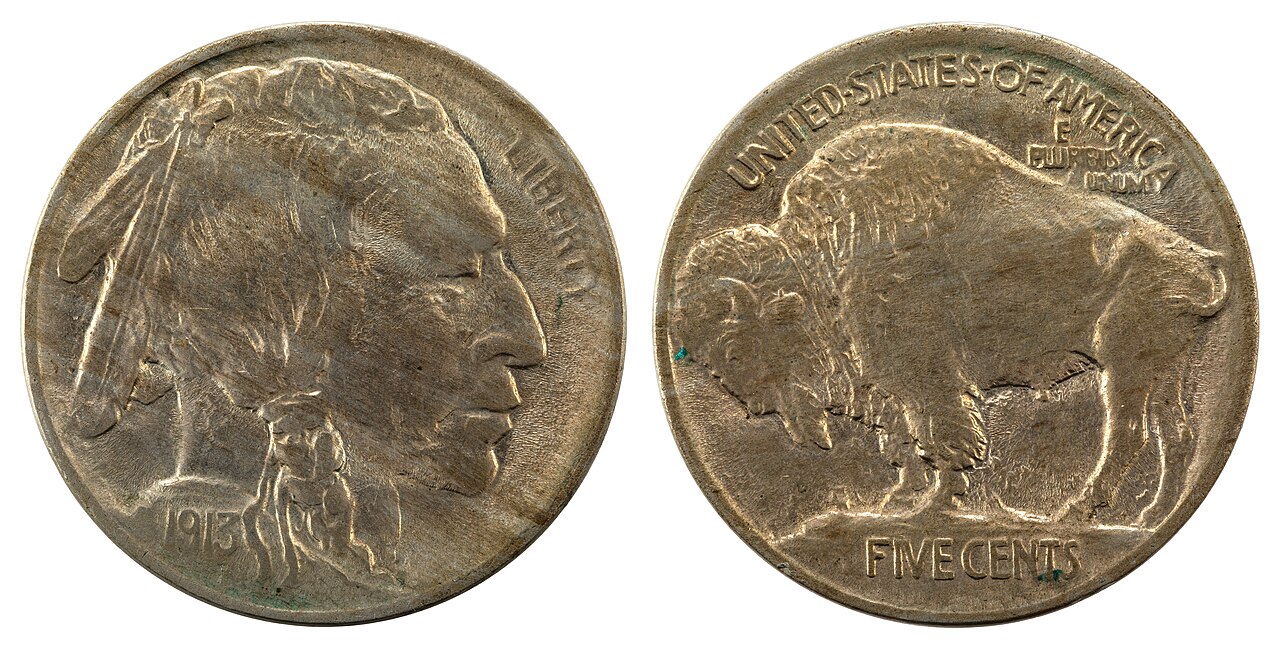
James Earle Fraser designed the nickel, which was minted from 1913 to 1938 and replaced by the Jefferson nickel. It is 75% copper and 25% nickel, weighs 5 grams, has a diameter of 21.21 mm and a plain edge.1 The obverse is a Native American portrait. Fraser said it was a composite and not a likeness of one person, naming Iron Tail, a Lakota, and Two Moons, a Cheyenne, as the main influences; the third model has never been settled.2 The bison on the reverse is usually said to be based on Black Diamond, a bull at the Central Park menagerie.2
Mintmarks (D for Denver, S for San Francisco, none for Philadelphia) are on the reverse, centred under FIVE CENTS.1
Type 1 and Type 2 in 1913
The first 1913 coins, now called Type 1, show the bison standing on a raised mound with FIVE CENTS on the mound. In March 1913 the engraver Charles Barber proposed changes because dies were being used up much faster than with the old Liberty Head nickel. The result, Type 2, has an enlarged FIVE CENTS legend and flat ground in place of the hill under the bison.1 The denomination had been wearing away on the mound; Wikipedia notes the changes actually reduced die life.1
How to tell them apart at a glance: Type 1 has a visible mound under the bison with FIVE CENTS on it; Type 2 has flat ground and the larger legend sits below it. The two types are collected separately. The Type 1 mintages were 30,992,000 at Philadelphia, 5,337,000 at Denver and 2,105,000 at San Francisco.3 The 1913-S Type 2 had a mintage of 1,209,000 and is a scarce coin, so check that both the S mintmark and the Type 2 reverse are right.4 There were also matte Proofs from 1913 to 1916 and brilliant Proofs in 1936 and 1937.2
My nickel has no date
Wikipedia states that the date and the denomination were the points most subject to wear, that the Mint tried to thicken the numerals, and that the problem was never fully solved.1 Many surviving Buffalo nickels are dateless, and they are common and usually inexpensive. Date wear is also a grading matter: if you want to collect by date, look for coins where the date is clearly legible, and ask a seller for close-up photographs of the date area before buying.
Can a date be restored?
Some collectors treat dateless nickels as a project. The metal under the date was compressed when the coin was struck, and a mild acid can eat the surrounding surface more slowly than the compressed numerals, so a faint date may reappear. This is destructive, since it takes metal off the coin. A reader letter in the Numismatic Bibliomania Society's E-Sylum newsletter reports that PCGS, NGC and ANACS will holder such coins and attribute varieties, and also that restored coins are worth much less than coins that have kept their date naturally.5 That is one collector's report and not a published service policy, so check the current rules of the service in question before assuming it. A coin whose date has been worn completely flat has no hardened metal left to reveal, and a coin that does give up a date is still a heavily worn coin. Do not experiment with acid on a coin that matters, and treat any "restored date" on a variety coin (a 1916 doubled die, a 1918/7-D or a 1937-D three-legged) with suspicion.
Key dates and varieties
- 1926-S. The lowest mintage of the series, at about 970,000; Wikipedia calls it the only date-and-mint combination below one million.1
- 1931-S. The initial mintage was only 194,000; it was later raised to 1,000,000 to discourage speculation.12
- 1913-S Type 2. Described above.
- 1916 doubled die obverse. The doubling is most visible on the date and is clear under magnification. One specialist site cites fewer than 500 known out of 63 million 1916 Philadelphia nickels, so almost all surviving coins you will meet in circulated condition are not this variety.6
- 1918/7-D overdate. A working die was hubbed with both 1917 and 1918 hubs. The 7 shows within the lower loop of the 8, with a straight line through the 8 and distortion at its top, visible even on worn coins. Counterfeits have circulated for decades and the variety was not noticed until 1930, so authentication matters.7
- 1935 doubled die reverse. Secondary images are visible on FIVE CENTS, and sometimes on E PLURIBUS UNUM and the wreath area.8
- 1937-D three-legged. A worn reverse die was damaged, probably by die clashing, and a Mint employee polished it so hard that the bison's front right leg was nearly removed. Montana dealer C.L. Franzen found examples in late 1937. Every genuine coin comes from one reverse die. Estimates give around 20,000 struck and roughly 10,000 survivors, mostly circulated. Genuine coins keep the hoof and show roughness on the missing leg; counterfeit and altered coins exist, so buy certified.9
- 1938-D/S. The last year of the series. Dies with an S mintmark were repunched with a D and used at Denver. Wikipedia says it was the first repunched mintmark of any US coin to be discovered, in 1962.1
Grading and strike
Buffalo nickels are hard to grade, because strike varies so much. NGC's guide says Denver and San Francisco coins from 1917 to 1927 are usually unevenly struck, with weak spots in the date, the Indian's braid and the bison's head, tail and shoulder, and that the 1926-D is notoriously poorly struck. The bison's horn is a traditional grading point, but the ANA now allows that the point of the horn is not always visible at VF-20, because many uncirculated coins lack a fully visible horn.10 Coins with little wear but a poor strike may therefore deserve a lower "net" grade than the wear alone would suggest.10
Condition problems
- Cleaning. NGC will not give a numeric grade to coins with abrasive or chemical cleaning, and uses its "Details" grades for them.11
- Environmental damage and corrosion. Pitting and staining from poor storage are described the same way.12
- Altered dates and mintmarks. Check any scarce date and mintmark combination (1913-S, 1926-S, 1931-S) against a certified example, especially when the coin is worn.
Storage and handling
Hold coins by the edges. The US Mint advises acid-free cardboard or plastic holders, warns against PVC, which can leave a sticky green film, and advises keeping coins cool and dry.13 Do not use metal polish or dips.
How to start
For a first purchase, a Type 2 coin from 1920 to 1938 with a legible date and a reasonable horn and braid is the best teacher. A date set is possible in circulated grades for most years; the 1926-S, 1913-S Type 2 and 1931-S are harder than the rest, and the three-legged and doubled-die coins are optional extras that should be bought certified. Look at a certified example of each type in a coin dealer's photos or a service's images, then compare yours with a 5x to 10x magnifier in good light.
Sort an inherited group before looking for a rare variety
Begin with three trays or inventory groups: readable date, partial date and no visible date. Within the readable group, record the year and reverse mintmark, then check whether a 1913 coin is Type 1 or Type 2. This organizes the collection without altering any surface or making a rarity claim from one worn detail.
| Photograph | What it helps document |
|---|---|
| Full obverse | Portrait, overall wear and the visible date |
| Date close-up | Which numerals can actually be read |
| Full reverse | The mound or ground, bison and denomination |
| Lower reverse detail | Mintmark position and surrounding surface |
For a possible three-legged or overdate specimen, photograph the whole coin as well as the suspected feature. A missing detail on a worn or damaged coin is a reason for comparison, not an automatic variety attribution.
Useful Buffalo nickel searches
Search 1913 Buffalo nickel Type 1 vs Type 2, Buffalo nickel reverse mintmark and the exact year-and-mint combination. For a dateless coin, search identification and date-wear references before searching prices for a guessed date.
Is a dateless Buffalo nickel worthless?
A readable date is important for a date-and-mint collection, but a dateless example can still be a design sample or teaching piece. Keep it described as dateless. Do not turn an uncertain digit into a key-date claim, and do not use restoration to create evidence that the original surface no longer supplies.
Sources and further reading
- Buffalo nickel, Wikipedia: specifications, Type 1 to Type 2 change, date wear, mintmark location, 1926-S, 1931-S, 1938-D/S.
- Buffalo Nickels: historical overview, Collector's Key: design, models, types, proofs, 1931-S. A coin dealer-education site.
- Buffalo nickel Type 1 (1913), CoinWeek
- 1913-S Type 2 Buffalo nickel, Collector's Key
- E-Sylum v19 n44, Numismatic Bibliomania Society: reader letter about acid-restored dates; anecdotal.
- 1916 doubled die obverse, Collector's Key
- 1918/7-D Buffalo nickel guide, CoinWeek
- 1935 doubled die reverse, Collector's Key
- 1937-D 3-legged Buffalo nickel, CoinWeek
- Grading Buffalo nickels, NGC
- NGC Details Grading, NGC
- NGC Details Descriptions glossary, NGC
- Caring for Your Coin Collection, US Mint (archived copy)