Indian Head cents (1859–1909): types, key dates and what to look for
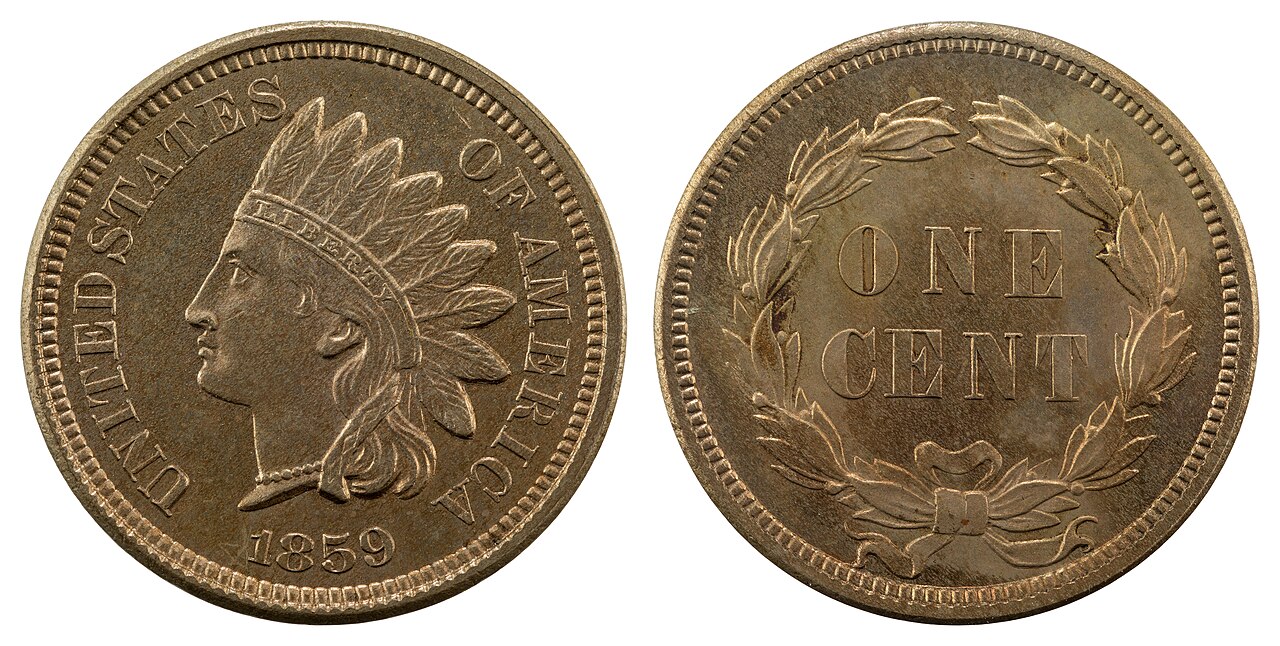
The Indian Head cent ran for fifty years and has several distinct types and varieties, which is the first thing to understand when you want to collect them. A listing that just says "Indian Head cent" can mean quite different coins, from a hard, heavy copper-nickel 1859 to a late bronze coin that looks much like a wheat cent in size.
.jpg)
.jpg#Licensing)
In this guide
What they are
James Barton Longacre, chief engraver at the Philadelphia Mint, designed the cent. The obverse shows Liberty wearing a Native American-style feather headdress with LIBERTY on the band, and the series ran from 1859 to 1909, when the Lincoln cent replaced it. It replaced the Flying Eagle cent, which had proved hard to strike.1 Mint Director James Ross Snowden recommended the change because of the Flying Eagle design's high relief.2 During the Civil War cents were hoarded, nickel was in short supply, and the Coinage Act of 1864 moved the cent to bronze.1
Which type is it?
| Period | Composition | Reverse |
|---|---|---|
| 1859 | 88% copper, 12% nickel | laurel wreath |
| 1860–1864 | 88% copper, 12% nickel | oak wreath with shield |
| 1864–1909 | 95% copper, 5% tin and zinc (bronze) | oak wreath with shield |
The laurel-wreath 1859 is a one-year type. Its copper-nickel alloy was hard on the dies, which led to the 1860 redesign of the reverse. Mint Director Snowden said the oak wreath and shield gave "more National character", according to Wikipedia.12 The change from copper-nickel to bronze in 1864 cut the weight from 72 to 48 grains, roughly 4.7 g to 3.11 g.3 Bronze cents have a warmer colour and are thinner. Copper-nickel cents are paler.
There is also a pointed-bust and rounded-bust difference on the obverse: all 1859 cents and some 1860 cents have the cutoff of Liberty's bust ending in a point, while most 1860 cents and all later issues have it rounded.1
Varieties worth knowing
- 1864 with and without L. In 1864 there are three coins: copper-nickel, bronze without L, and bronze with an L. Longacre sharpened his design for the softer bronze and added his initial L on the ribbon behind Liberty's ear, partway through the year, so fewer L coins were struck. The L is small, and Fine or better is recommended for confident identification without magnification.14 Check the ribbon under a loupe; on worn coins the L is the first thing to go.
- 1869/9. A repunched date that was once listed as an overdate with an 8 under the 9; later work showed the underlying digit is another 9.1
- 1873 Close 3 and Open 3. The 3 was thought to look like an 8, so chief engraver William Barber modified it to the Open 3.1 In a Closed 3 the upper and lower arms of the numeral curve in and nearly touch; in an Open 3 they end clearly apart.5 The total 1873 mintage was 11,676,500.6 There is also a scarce Doubled LIBERTY variety for 1873, in which the letters of LIBERTY on the headband show doubling; look for it with a loupe, and buy certified.5
- 1886 Type I and Type II. The obverse was slightly modified in 1886. On Type I the lowest feather of the headdress points between the I and the C of AMERICA, and on Type II it points between the C and the final A.1 The feather position is reliable only on coins that are Fine or better.7 Sources disagree on which type is scarcer, so check a current reference rather than assuming.
- 1888/7. A repunched date, noted along with 1869/9 by one reference site.3
The key dates
- 1877. Only 852,500 were minted, making it the key date and one of only two issues with a mintage below a million.1
- 1909-S. The lowest mintage of the series, at 309,000, and the last issue of the series.1
- 1908-S. Scarce, with 1,115,000 struck.1
Wikipedia notes that small quantities of cents were struck at San Francisco in 1908 and 1909, and the S mintmark sits below the wreath on the reverse.1 At the other end, 1907 was the first year the mintage exceeded 100 million, at 108.1 million, so late-date coins are plentiful. 1909 Philadelphia cents were 14.4 million.1
Grading
Early copper-nickel cents and some bronze dates after 1890 may be softly struck, and NGC allows for this when grading. Because copper-nickel cents are heavy and hard, they pick up nicks and abrasions from contact, so high-grade pieces from before 1897 or so are scarcer than later ones.8 Certified bronze cents carry a colour suffix: BN (brown), RB (red and brown) or RD (red, nearly all original colour).8 Brown is simply age, and is a perfectly good condition for most dates.
What goes wrong
- Cleaning. Improperly cleaned or damaged coins may be eligible for NGC Details grading instead of a numeric grade, with the surface problem stated on the label. Conservation and grading are distinct services; a Details label does not mean the damage has been repaired.9
- Counterfeits. NGC has reported fakes of Indian Head cents, including an 1875 copy with fat, lopsided date digits, weak edge definition and odd raised lines, such as one behind the jaw.10
- Altered mintmarks. An S added to a plain 1908 or 1909 coin is the obvious way to fake the two San Francisco keys. NGC's work on the 1909-S VDB Lincoln cent shows the general method: compare the mintmark's shape and position with known genuine coins under magnification.11 For the Indian Head keys, buy coins certified.
- Environmental damage. Pitting and corrosion are described by NGC as damage, and the coin can't be graded numerically.12
Storing and handling
Hold coins by the edges and keep them in holders without PVC; the US Mint says PVC can coat coins with a sticky green film, and advises cool, dry storage.13 Do not polish them.
Starting a set
A type set is the sensible start: an 1859 laurel, a copper-nickel oak wreath cent from 1860 to 1864, an 1864 bronze, a mid-series bronze and a late-date coin. After that, try a run of dates by decade, add the 1864 L, 1873 and 1886 varieties, and leave the 1877, 1908-S and 1909-S to last, certified. For common dates, choose the best-looking example you can afford and look at the whole coin, not only the date.
A four-step identification check for an Indian Head cent
Read the date first, then inspect the reverse wreath and any mintmark. For an 1864 coin, check the metal type and the ribbon detail separately; a date alone does not distinguish every issue discussed above. For an 1886 coin, compare the feather position with a clear reference rather than inferring the type from a seller's title.
| Question | Detail to photograph |
|---|---|
| Laurel or oak wreath? | Full reverse, including the upper wreath area |
| Copper-nickel or bronze issue? | Both faces, edge and a measured weight |
| 1864 L variety? | Ribbon behind the portrait, with the whole obverse for context |
| San Francisco issue? | Lower reverse below the wreath |
On a worn coin, mark a feature as unreadable when the photograph does not support a confident identification. A missing visible L or mintmark is not a reason to supply a guess from the date.
Searching for references rather than broad listings
Try Indian Head cent 1859 laurel wreath, 1864 Indian Head cent L ribbon and 1886 Indian Head cent Type I Type II. For the 1908-S or 1909-S, include the mintmark in every comparison and request a close-up of the actual coin offered.
Brown or bright copper: which should a beginner choose?
Compare legibility, wear and surface problems before choosing by color. Brown is a recognized color designation, not a defect by itself. A bright photograph does not establish original color or the absence of cleaning; ask for neutral-light images and the holder's exact attribution, where applicable.
Sources and further reading
- Indian Head cent, Wikipedia: design history, composition, varieties and mintages.
- A guide to collecting the Indian Head penny, CoinWeek: Snowden and the Flying Eagle, 1859 reverse; a coin dealer's sponsored guide.
- Indian Head cent, Numisview: composition, weight change and overdates.
- 1864 L on ribbon, Collector's Key
- 1873 Indian Head cent varieties, Collector's Key
- 1873 Indian Head cent, Numisview
- 1886 Type 1 vs Type 2, Collector's Key
- Grading Indian cents, NGC
- NGC Details Grading, NGC
- Counterfeit Detection: 1875 Indian Head Cent, NGC
- Counterfeit Detection: Authenticating 1909-S VDB Lincoln Cents, NGC: a different series, but the same method.
- NGC Details Descriptions glossary, NGC
- Caring for Your Coin Collection, US Mint (archived copy)