Lincoln wheat cents (1909–1958): key dates, 1943 steel and how to start
Wheat cents are the most approachable coin series in US collecting: they are old enough to be interesting, were made in huge numbers, and can still be found in bulk lots and old jars. The questions people have when they start are which ones are special, why some look different, which "rare" coins are really altered, and how not to ruin what they have.
.jpg)
.jpg#Licensing)
In this guide
What a wheat cent is
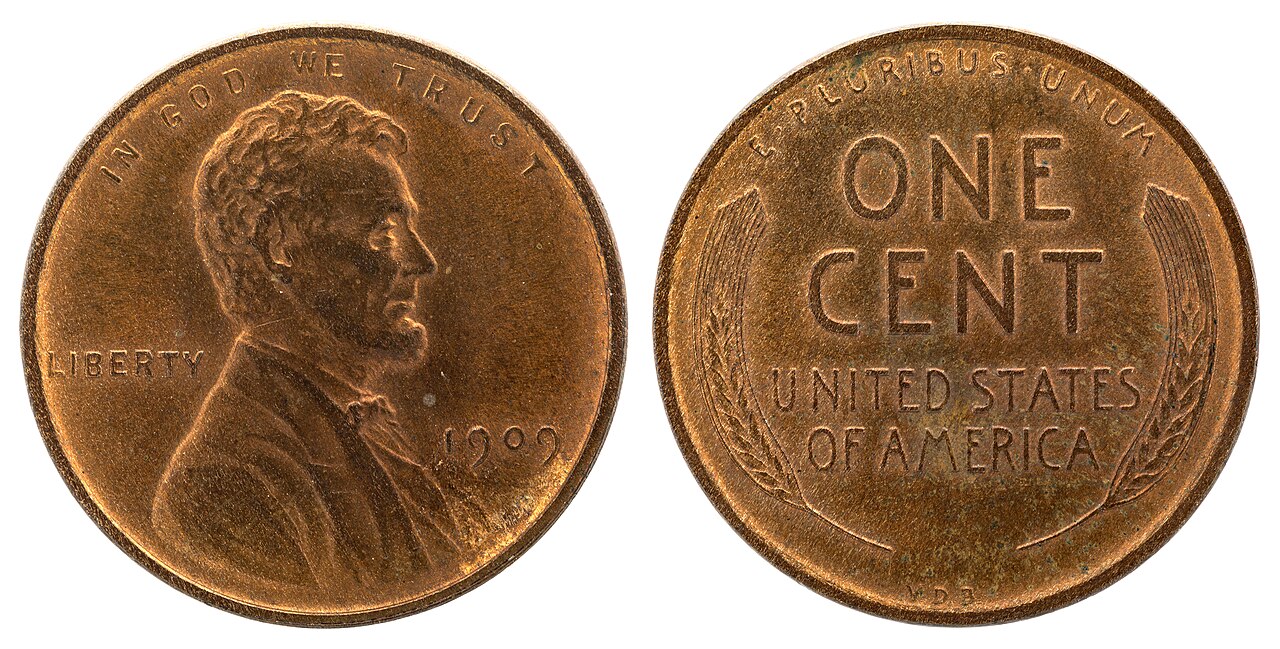
Victor David Brenner designed the Lincoln cent, which debuted in 1909 with two wheat ears on the reverse. The obverse portrait was based on an 1864 photograph by Mathew Brady. The wheat reverse ran until 1958; from 1959 the reverse showed the Lincoln Memorial, designed by Frank Gasparro, for the 150th anniversary of Lincoln's birth.1
| Detail | Value |
|---|---|
| Diameter | 19.05 mm |
| Weight (bronze, 1909–1942 and 1944–1958) | 3.11 g |
| Weight (1943 steel) | 2.7 g |
| Composition | 95% copper, remainder tin or zinc |
| 1943 | zinc-coated steel |
| 1944–1946 | 95% copper, 5% zinc |
Source: Wikipedia.1
The mintmark (D for Denver, S for San Francisco, none for Philadelphia) sits below the date on the obverse.1
How the metal changed
Pre-1943 cents are bronze, 95% copper with tin or zinc making up the rest. In 1943, with copper needed for the war effort, the Mint struck zinc-coated steel cents instead. Wikipedia reports a 1943 total of about 1.09 billion steel cents across the three mints.1 Production began on 27 February 1943 and ran to the end of that year.2
The experiment was unpopular. Steel cents looked like dimes to some people, and the zinc coating did not protect the cut edges, so they rusted readily; the magnets that vending machines used to reject steel slugs also rejected genuine steel cents.3 In December 1943 the Treasury announced the return of copper-based cents. The 1944–1946 cents were struck from an alloy that includes salvaged brass cartridge cases, with copper added to bring it close to the old composition.3 Numismatic writer Shane Anderson doubts shells were actually melted for the coins except perhaps ceremonially, so treat "made from shell casings" as the official story rather than a measured fact.1 Coins from these years are often called shell-case cents; they are common and look like any other bronze cent.
Why is my 1943 cent grey and magnetic?
Because it is supposed to be. A zinc-coated steel cent is silvery when new, dull grey or mottled after wear, and is the only regular-issue US coin a magnet will lift.3 That is the normal 1943 cent, not a rare error.
The rarities are the opposite way round: a few 1943 cents were struck on leftover bronze blanks, and a few 1944 cents on leftover steel blanks. Wikipedia describes the 1943 copper cents as an estimated 40 pieces struck, with only 13 confirmed, and says that "ten or fewer" 1944-D steel cents are known.13 Other specialist sites quote different population counts, so the exact numbers are not settled. What matters for a beginner:
- A genuine 1943 copper cent is not magnetic and weighs about 3.11 g, against about 2.7 g for steel.3
- Fakes are made by copper-plating a steel cent (it will still stick to a magnet) or by altering the last digit of a 1945, 1948 or 1949 cent. The 3 in a real 1943 has the long tail seen on genuine steel cents, and an altered coin looks wrong beside a normal 1943.3
- A non-magnetic 1943 or magnetic 1944 cent should be treated as unproven until a major grading service has authenticated it. Never pay anything on the strength of a seller's description.
Key dates and varieties
Most wheat cents are common. These are the ones collectors single out, and how to tell them apart.
1909 VDB and 1909-S VDB. Brenner's initials appeared at the bottom of the reverse on the first cents. Newspapers questioned whether they amounted to advertising, and on 5 August 1909 Treasury Secretary Franklin MacVeagh ordered production halted until they were removed; coins without the initials were being made by 12 August. About 28 million VDB cents were struck at Philadelphia, but only 484,000 of the San Francisco VDB cents were released. Brenner's initials came back in small form on Lincoln's shoulder in 1918.14 A 1909 cent with VDB on the reverse base and no mintmark is the common Philadelphia coin; only an S under the date makes it the scarce one, which is why the added-S fakes below exist.
1914-D, 1922 No D and 1931-S. The Denver 1914 and the San Francisco 1931 are the other well-known low-mintage dates, and 1922 is unique in that only Denver struck cents that year, so every 1922 cent is a Denver coin whether or not it shows a D.1
1922 Plain (No D) versus Weak D. Grease and dirt filling the mintmark in the die, or die wear, produced 1922 cents with a faint or invisible D. One die pair is different: it shows no trace of a D because a mint employee polished the mintmark away while repairing a damaged die. Identifying it relies on a sharp reverse with clear wheat lines and clearly formed letters in TRUST, on an otherwise weakly detailed obverse. NGC and PCGS divide these into more categories than ANACS, which recognizes only that one die pair as "No D".5 A cent with a D removed by a file or tool is not the variety, so buy these certified.
1943 copper and 1944 steel. Covered above.
Doubled dies. In 1955 a misaligned hub produced a Philadelphia obverse die with strongly doubled date and lettering. Wikipedia's account estimates about 40,000 were struck in one shift and 20,000 to 24,000 released, many through vending machines. Genuine examples show doubling in the date and in IN GOD WE TRUST; the common fakes are machine-doubled coins with flat, shelf-like doubling, so authenticate any you find.6 Other recognized wheat-era doubled dies include 1917, 1936 and 1958.7
Grading and colour
Because the series is bronze, certified coins carry a colour designation: RD (red), RB (red-brown) or BN (brown). NGC requires at least 85% of the original red luster for RD, at least 15% for RB and less than 15% for BN.8 Brown coins are not damaged, they are simply aged, and the change is permanent; a coin that has been made red again artificially is described by NGC as "Altered Color".9
For grading itself, NGC's guide notes that many Denver and San Francisco cents from 1911 to 1927 were struck from worn dies, and that a weakly struck coin with strong luster is not the same as a worn coin. Surface marks matter most in open fields and near the date and mintmark, because the coin is so small.10
What to watch out for
- Added mintmarks. The 1909-S VDB is described by NGC as the most commonly altered and counterfeited collectible coin in the world, made by adding an S to a Philadelphia VDB. A genuine S has a small raised dot inside its top curve and straight (not slanted) serifs, and its position must match one of four known obverse die positions. The VDB initials on a genuine coin have angled crossbars on the B and a slanted base on the D.11
- Altered dates. The 1943 and 1944 cases above are the most common; low-mintage dates such as 1914-D are also worth buying certified.
- Cleaning. Cleaning removes original surface. NGC places coins with abrasive or chemical cleaning in a "Details" category rather than giving a numeric grade, and describes copper coins that have been brightened as altered color.12
- Corrosion and green spots. Pitting, verdigris and spotting are environmental damage and cannot be undone safely.
Storing and handling
Hold coins by the edges over a soft surface and avoid breathing or speaking over them. The US Mint advises acid-free cardboard or plastic holders, and warns against PVC, which can leave a sticky green film. Keep coins cool and dry.13 If a coin is dirty, do not polish it; the Mint's page says only mild soap and water if you must, then pat dry.13 For most coins the better answer is to leave them alone.
How to start a set
- Sort bulk cents by date and mintmark first. Everything without a mintmark is Philadelphia; D and S are under the date.
- A date-and-mint set from 1909 to 1958 has well over a hundred coins, but the common ones are inexpensive and the hard ones can be left until last. A smaller goal is one cent per decade, or a type set: 1909 VDB, 1909 plain, then the standard design to 1958 plus the 1943 steel.
- Buy the first scarce coins already certified by NGC or PCGS, and check the certificate number on the service's website.
- Make your first purchases coins you can afford to be wrong about: the 1943 steel, a shell-case 1944, and a Brown 1950s coin in good condition teach grading, colour and luster better than a key date will.
- Use a 5x to 10x magnifier, good light and an album or flips made without PVC.
Sorting wheat cents: a practical first pass
Make an inventory with columns for date, mintmark, VDB where relevant, color, obvious surface damage and any claimed variety. Separate the normal 1943 steel cents so their different appearance does not dominate the rest of the search. Leave uncertain errors and varieties in a separate group for closer study rather than naming them immediately.
| Group | Useful next step |
|---|---|
| Readable ordinary dates | Sort by date and mintmark for an album checklist |
| 1909 coins | Photograph the reverse base and obverse mintmark area |
| 1943 or 1944 metal questions | Record the date, measured weight and magnetic response |
| Possible doubled dies | Compare the whole lettering and date with an attributed reference |
| Corroded or unreadable coins | Record the limitation; avoid abrasive attempts to expose detail |
A magnetic response can help screen the wartime metal question, but it cannot authenticate an unusual cent. An apparent error needs agreement among its date, metal, design and professional attribution, rather than one surprising test result.
Search phrases that reduce misleading results
Use 1909 VDB vs 1909 S VDB, 1922 Lincoln cent No D vs Weak D and 1943 steel cent vs copper plated. For doubled dies, include the date and the design area that appears doubled. A broad 'rare wheat penny' search mixes ordinary coins, altered pieces and genuine varieties.
Should every older cent be sent for grading?
First identify what you have and what question grading would answer. A readable common-date album coin and a suspected altered key date present different needs. If a coin is already certified, match the holder description and verification record to the physical example rather than relying on a photographed certificate alone.
Video demonstrations
The NGC Grading Process
Sources and further reading
- Lincoln cent, Wikipedia: design, composition, mintages, 1909 VDB, 1943 steel, 1944 steel, shell-case cents, 1955 doubled die.
- 1943 Lincoln steel pennies, CoinWeek: production dates and appearance of the steel cent.
- 1943 steel cent, Wikipedia: magnet test, rust, vending machines, copper cents and counterfeits.
- Lincoln cent, Wikipedia: the VDB dates (5 and 12 August 1909) and the 1918 restoration of the initials.
- 1922 Lincoln cent die pair analysis, Lincoln Cent Resource: die pairs, diagnostics, grading service differences.
- 1955 doubled die cent, Wikipedia: origin, quantities, counterfeits.
- Lincoln wheat cent 1909-1958, CoinWeek: doubled die years and colour designations.
- Learn Grading: What are BN, RB and RD?, NGC
- NGC Details Descriptions glossary, NGC: definitions of cleaned, environmental damage, corrosion and altered color.
- Grading Lincoln cents, NGC
- Counterfeit Detection: Authenticating 1909-S VDB Lincoln Cents, NGC
- NGC Details Grading, NGC
- Caring for Your Coin Collection, US Mint (archived copy)