Peace dollars (1921–1935): key dates, the 1964-D story and what to check
Peace dollars are large silver coins that many people encounter through inherited collections. The common questions are which ones are special, how to tell a genuine key date from a doctored one, and whether the stories about the 1964 date are true.


In this guide
What they are
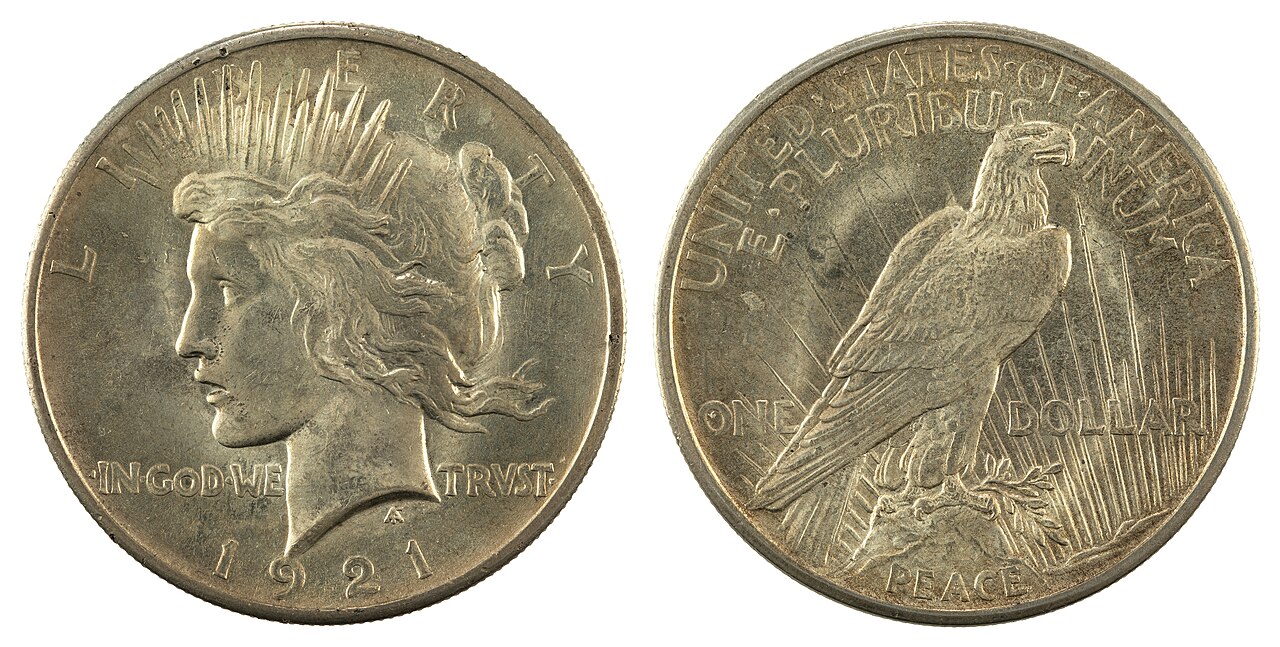
The Peace dollar was designed by Anthony de Francisci and minted from 1921 to 1928 and again in 1934 and 1935. The original coins are 90% silver and 10% copper, weigh 26.73 grams and are 38.1 mm across.1 The obverse shows Liberty wearing a radiate crown, modelled on de Francisci's wife Teresa, and the reverse shows a perched eagle with an olive branch and the word PEACE. De Francisci's original reverse had a broken sword, which was removed after public criticism.2 The mintmark, a D or S, is on the reverse below the word ONE and near the tip of the eagle's wing; Philadelphia coins have no mintmark.23
Modern collector versions, from 2021, use .999 silver.1
Why were they made?
Under the Pittman Act of 1918 the Treasury had to strike millions of silver dollars to replace silver that had been melted. Numismatists argued for a design commemorating the peace after World War I, and the Peace dollar replaced the Morgan design.12 The first coins were struck on 28 December 1921 and entered circulation on 3 January 1922.2 Production stopped after 1928 when the Pittman Act requirements were met, and resumed in 1934 and 1935 after legislation required more domestic silver purchases, with over seven million struck in those two years.2
Mintages at a glance
| Year | Philadelphia | Denver | San Francisco |
|---|---|---|---|
| 1921 | 1,006,473 | none | none |
| 1922 | 51,737,000 | 15,063,000 | 17,475,000 |
| 1923 | 30,800,000 | 6,811,000 | 19,020,000 |
| 1924 | 11,811,000 | none | 1,728,000 |
| 1925 | 10,198,000 | none | 1,610,000 |
| 1926 | 1,939,000 | 2,348,700 | 6,980,000 |
| 1927 | 848,000 | 1,268,900 | 866,000 |
| 1928 | 360,649 | none | 1,632,000 |
| 1934 | 954,057 | 1,569,500 | 1,011,000 |
| 1935 | 1,576,000 | none | 1,964,000 |
Source: Wikipedia, with the San Francisco issues cross-checked against PCGS and NGC.24567 The 1922 total across the three mints was over 84 million, so 1922 and 1923 are the common dates.
The dates that matter
1921 high relief. The 1921 coin is the only high-relief business strike in the series. The high relief took too much pressure to strike fully and wore out dies quickly, so de Francisci modified the design early in 1922 to lower the relief.2 Compare a 1921 against a certified example, since the difference from the lower-relief 1922 design is in how much the portrait rises from the field. Weak strikes are common, and sharply struck examples are in demand.8 A tiny number of 1922 high relief pieces also exist, described by Wikipedia as coins in which relief was partly kept in January 1922, almost all of which were melted. Sources disagree on how many were struck and on whether any circulated, and this is far outside beginner territory.2
1928-P. The lowest mintage of the series at 360,649. NGC's counterfeit notes say the 1928 is a target: many fakes are altered 1923 coins, with the 8 looking tooled and standing out from the other digits. Another counterfeit paired a 1928 date with a 1921-style reverse, identifiable by a third ray below ONE, which only the 1921 has.9
NGC lists four genuine 1928 obverse dies with distinctive raised die-polish lines near LIBERTY, which add confidence but are not foolproof authentication.9
1934-D and 1934-S. The 1934-D had a mintage of 1,569,500, the largest of the 1934 mints, but it does not seem to have surfaced in large original bags, so Mint State examples are scarce. It also has a doubled-die variety (VAM-3) with doubling on Liberty's face and tiara rays, and variants with different mintmark sizes.3 Jeff Garrett's NGC article calls the 1934-S the rarest date of the series in high grade.8
1926 God. A modification discovered in 1999 shows the word GOD slightly bolder in the motto on 1926 dollars from all mints; the Mint's records do not explain it.2
The 1964-D story
In 1964 Congress authorized 45 million new silver dollars after Western senators, from silver-producing states, bargained for them in return for support for changing the dimes, quarters and half dollars. President Lyndon Johnson signed the appropriation in August 1964, and the Denver Mint prepared new dies and hubs on the Peace dollar design, because the 1935 dies and hubs had been destroyed in 1937. From 13 to 24 May 1965 it struck 316,076 coins dated 1964.10 The order was withdrawn on 25 May amid congressional criticism and speculation by dealers, and Mint Director Eva Adams described the coins as experimental or trial pieces.10
All the coins were officially melted, and the dies destroyed. The weak point is the way the melting was checked: by weight, not by counting, which led to speculation that someone could have substituted another Peace dollar of a different date for a 1964-D. Adams stated that all steps were taken to ensure none went missing. Some stories say Denver employees were allowed to buy coins, but employees have said in the numismatic press that this did not happen.10 No genuine example is known to the public. PCGS offered a $10,000 reward in 2013 simply to view a real example, with no takers reported by CoinWeek, which adds that any real example would be government property subject to seizure.102 Treat any claimed 1964-D Peace dollar as not genuine unless a major grading service has authenticated it.
Grading and eye appeal
The hardest call is telling a truly uncirculated coin from a lightly worn "slider": NGC says to look for the slight dulling of luster that signals circulation, and notes that most Mint State coins fall between MS-60 and MS-62. Marks on Liberty's cheek, the fields, the eagle or the date matter most at higher grades. Peace dollars tone irregularly or blotchily, not the attractive pattern of many Morgan dollars.11
San Francisco coins of the 1920s are nearly all softly struck in places, with rare exceptions in 1922-S and 1926-S.11 Jeff Garrett adds that 1922 and 1923 dollars often have white water spots, which come from poor planchet rinsing; record the spotting when comparing condition.8
Cleaning and other problems
- Hairlines and cleaning. Silver coins are easily wiped, and fine hairlines show best when you tilt the coin under a single bright light. Buying certified coins is the practical protection. Do not polish yours: NGC places coins with abrasive or chemical cleaning in a "Details" category rather than giving a numeric grade.12
- Altered dates. 1923 to 1928 is the standard alteration, as above.
- Counterfeits. A counterfeit 1921 examined by NGC was about a gram overweight at 27.7 g, with only a trace of silver, proof-like fields and raised lumps on the devices. A scale reading 26.73 g is not proof of genuineness but a clear mismatch is a warning.131
- Environmental damage and corrosion. NGC treats them as damage with a Details grade.14
Storing and handling
Hold dollars by the edge over a soft surface. The US Mint advises acid-free holders, no PVC, cool and dry storage, and says not to polish.15 Large coins scuff easily when stacked or loose.
Starting out
Most Peace dollars are common and sold for modest amounts above their silver content, so the easiest first coins are a 1922, 1923, 1924 or 1925 in nice condition. Those same coins will teach you luster and strike better than a key date. Build by date and mint, leave the 1928, the 1934-S and the 1921 until last, and buy those certified. If you have inherited a group of Peace dollars, sort them by date and mintmark first, and look at the 1921, 1928, 1934-D and 1934-S carefully before you do anything else.
Read a Peace dollar listing by date, mint and strike
Start with the date and reverse mintmark, then distinguish the original circulation series from modern collector releases. 'Peace silver dollar' covers more than one product era. A modern boxed coin is not an original 1920s issue, and a historic Philadelphia coin may be listed as 'P' even though no P is physically present.
| Your objective | What to put in the search |
|---|---|
| Original circulation coin | Exact date, mintmark and Peace dollar |
| First-year design sample | 1921 Peace dollar high relief |
| Philadelphia key date | 1928 Peace dollar no mintmark |
| San Francisco 1928 issue | 1928-S Peace dollar |
| Modern collector coin | Year, finish and official product description |
Photograph the mintmark area, not only Liberty
A sharp portrait photograph can be attractive while leaving the issue identity unresolved. Request a full reverse plus a close-up of the mintmark area. For a claimed Philadelphia 1928, the absence of an S must be consistent with an original surface, not an area from which lettering was removed.
A checklist for an inherited roll or bag
Inventory each date-and-mint combination before making assumptions from the group's appearance. Keep notes on corrosion, scratches and holder labels separately from the identification. Common-looking dates still deserve a clear record, while a suspected key date needs individual photographs and authentication. Avoid assigning one grade or one provenance claim to an entire mixed group: the important differences may be on the reverse of only one coin.
Sources and further reading
- Peace dollar, Wikipedia: specifications, history, 1964-D, modern issues.
- Peace dollar, Wikipedia: production, mintages by mint, relief change, 1926 motto.
- 1934-D Peace dollar, CoinWeek: mintmark position, 1934-D varieties, survival.
- 1924-S Peace dollar, PCGS CoinFacts: San Francisco mintage of 1,728,000; no Denver issue.
- 1925-S Peace dollar, PCGS CoinFacts: San Francisco mintage of 1,610,000.
- 1928-S Peace dollar, PCGS CoinFacts: San Francisco mintage of 1,632,000.
- 1935-S Peace dollar, NGC Coin Explorer: San Francisco mintage of 1,964,000.
- Jeff Garrett: Collecting US Peace Dollars, NGC
- Counterfeit Detection: 1928 Peace Dollar, NGC
- The Mystery of the 1964-D Peace Dollar, CoinWeek
- Grading Peace dollars, NGC
- NGC Details Grading, NGC
- Counterfeit Detection: 1921 Peace Dollar, NGC
- NGC Details Descriptions glossary, NGC
- Caring for Your Coin Collection, US Mint (archived copy)